

























































































































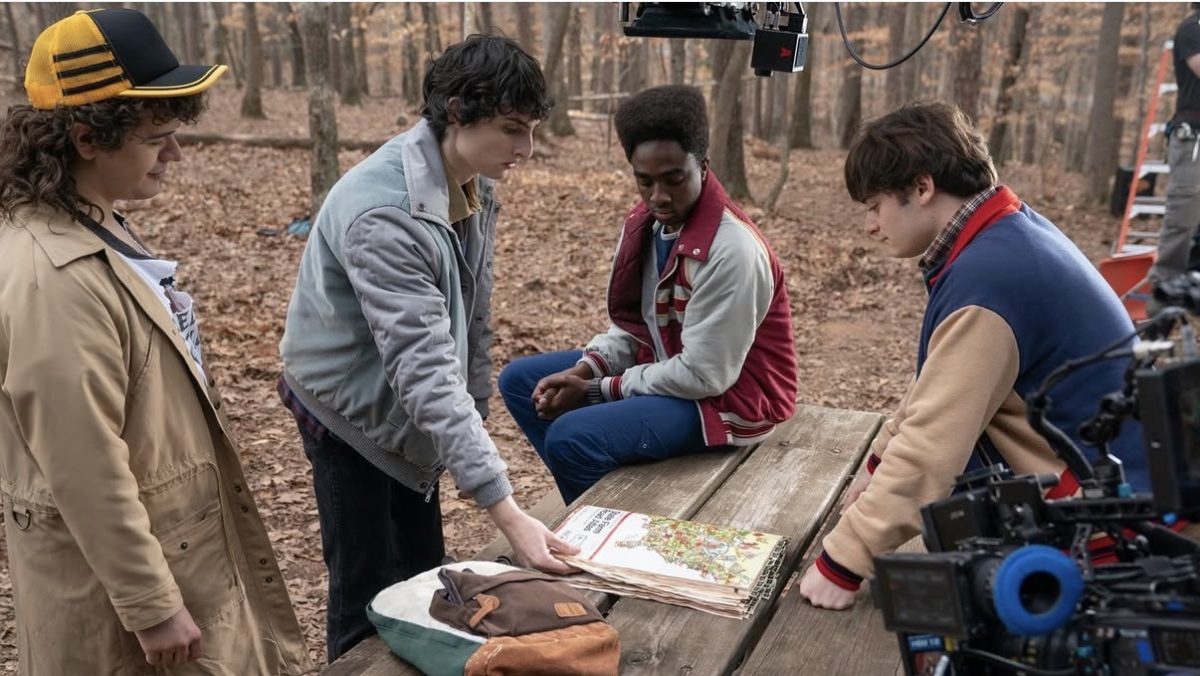
To simply call the Netflix original series “Stranger Things” a television show is to severely discredit its impact on the cultural zeitgeist; “Stranger Things” is more aptly titled a cultural phenomenon. I remember when season two of the show had just released and I began watching. I was quickly enamored with the quirky ensemble of child protagonists ranging from Dungeons and Dragons (D&D) connoisseurs to a telekinetic, supernatural heroine on the run from the United States government. The characters work together to fight off horrifying beings from another realm they choose to call the Upside Down in order to save the town they live in and find their missing friend. I found comfort in seeing characters who aren’t perfect, who just want to do their best to discover the dark truths that lie underneath their town of Hawkins, Indiana. As I kept watching, I couldn’t wait to see what adventures they would continue to have as more seasons were released. So, when I say that a show that had so much love and care put into it, that seemed to do just about everything right, ended on such a disappointing, dull nothing-burger of a conclusion, it should be pretty startling, and that’s because it is indeed startling.
The creators of “Stranger Things,” Ross and Matt Duffer, had a job the weight and size of a boulder thrust upon them. Somehow, someway, they had to conclude their television show which had risen to become the biggest show in the world. No matter what they did, of course, they couldn’t satisfy each of the 120 million viewers of their last season. Still, some people — including me — argue that they could have done so much more than what they delivered. I’m not mad, just disappointed.
One of “Stranger Things” worst crimes is its refusal to put any of its characters in the grave, thus snuffing out almost all of the tension and stakes. In the series finale, titled “The Rightside Up,” the main cast of characters must defeat the show’s final antagonists, Vecna and the Mind Flayer, and miraculously, they are able to do so without a scratch on any of the multiple characters present at the final battle. Vecna is defeated mostly by Eleven, a girl with telekinetic powers, whose life is never threatened. I love these characters deeply and was happy all of them made it out alive, but I would’ve appreciated the possibility of a couple deaths. The episode had tried to do this with Steve Harrington, a main character, in the first half of the two-hour special but failed spectacularly to raise the stakes or plot in any way.
The final season of “Stranger Things” focuses far too much on the newly introduced side characters for the ending to have any true payoff for the whole series. For example, the group of 12 children Vecna kidnapped throughout the season had no impact on the result of the finale, nor did they contribute to the ending fight at all and took valuable screentime away from the main cast. Vecna’s plan to use these children for his master plan is also completely redundant and frankly stupid, in my opinion. Nothing in season five of “Stranger Things” — like the children’s kidnappings and the military that is on the hunt for Eleven — amounts to anything.
The final 50 minutes of the finale features a year-and-a-half jump with the main characters graduating high school and moving on from the horrors they faced. It’s a very heart-warming segment made for the true, longtime fans of the series and a segment that hit me very hard emotionally. I also just recently graduated high school, and to watch the young adults in the show grapple with college life and a life outside of high school was really touching, relevant and something I wanted to see from the finale.
In the final scene of the finale, Mike Wheeler, in a D&D campaign, shares his belief to the other characters that Eleven possibly survived, being swallowed up by the destruction of the Upside Down in a way that allows the audience to decide for themselves whether Mike’s theory is true or not. It pleases both sides of the viewers: One side that is happy to finally see a character get axed, and the other side that wanted Eleven to survive. It’s a great way to end the series and is one of the only things the finale did right.
In short, “The Rightside Up” was rushed. Season five began filming before the Duffer brothers were done with the finale’s script, and it’s apparent. Truly, the last season of “Stranger Things” is one of only a few blunders the show ever had, and it’s a shame that what I would consider a near-perfect piece of media had to fizzle out so poorly. Let this final episode be a lesson to all creators out there to fully think through their finales and give them the time and effort they deserve. While there will never be another “Stranger Things,” there will hopefully be another perfect finale.