


















































The playing field is no longer a neutral sanctuary; it is a geopolitical battleground. Political and bureaucratic tensions have direct impacts on international sporting competitions. Players are forced to sit out competition due to their country’s global political status or an inability to acquire a visa for entry. Athletes face public backlash when representing a controversial country, and public unrest has disrupted proceedings at multiple events.
Persecuted groups are using the expansive reach and popularity of sports to make their issues heard, aiming to put themselves into the public eye, prompt action from lawmakers and gain traction in their movements. Athletes themselves use their platforms to spread messages, often jeopardizing their eligibility. Sports have become a new platform for protest.
Ahead of the Milano Cortina Winter Olympics, the audience was outraged to learn that officers from the United States Immigration and Customs Enforcement (ICE) would be at the games.
According to The Athletic, the Mayor of Milan, Isko Moreno, vocalized his disagreement with this new installment, calling ICE “‘a militia that kills.’” Before the games, Italians gathered to protest the impending arrival of ICE, infuriated with the violation of Italian sovereignty. It turns out there was a misconception about ICE’s role in Milan; the department that went to Italy was Homeland Security Investigations (HSI), which attends most major sporting events for security purposes.
Regardless, people were willing to publicly oppose ICE, despite the dubious validity of their arguments.
The Olympics were also an ideal stage for many to vocalize their dismay with the relentless conflict in Ukraine. Famously, Ukrainian athlete Vladyslav Heraskevych was banned from Olympic participation for depictions of fallen soldiers on his helmet. Olympic officials claimed this violated rules regarding prohibited political speech during competition.
According to NPR, Heraskevych was adamant to insist “‘The memory of fallen athletes, coaches, civilians and defenders of Ukraine cannot and should not be considered a political demonstration.’”
This controversy drew a massive international audience. Ukrainian President Volodymyr Zelenskyy spoke out against the International Olympic Committee (IOC) and other Ukrainian athletes stood in solidarity with their teammate by way of their own displays of remembrance for fallen soldiers. Many were upset with the double standard being set by the IOC, as they allowed 20 Russian and Belarusian athletes to compete.
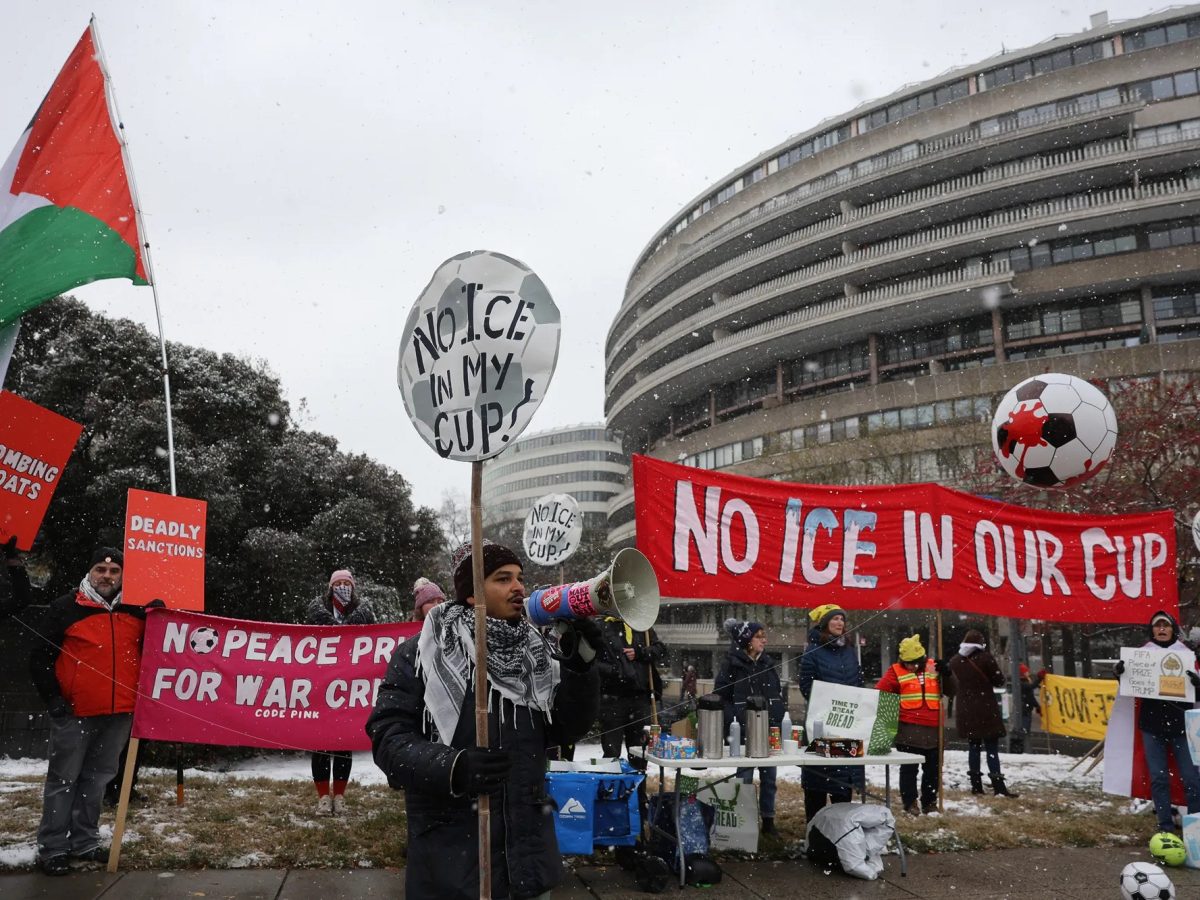
In December, protestors expressed their disapproval of FIFA President Gianni Infantino as he awarded President Donald Trump with the inaugural FIFA Peace Prize while he was in Washington, D.C. Protesters used the slogan “No ICE in my Cup,” calling out the continued violence inflicted by ICE agents. The mix of soccer fans and activists were calling for Infantino to publicly denounce Trump’s white supremacy ahead of the 2026 FIFA World Cup taking place in Canada, the United States and Mexico. Protestors also flew a Palestinian flag to represent the at least 437 Palestinian soccer players murdered by Israeli forces.
Additionally, in relation to the impending World Cup, the Iranian National Soccer Team has hinted at boycotting the World Cup in response to the recent U.S. attacks on the country. U.S. and Israeli strikes have devastated areas of Iran, killing their Supreme Leader Ayatollah Ali Khamenei and upwards of 1,200 citizens. Communicating with the Iranian football officials has been challenging due to rolling blackouts across the country. This geopolitical forfeit of this large-scale torment is Iran’s effort to protest the U.S. government.
The fight for gender equality has been brought into the stadium, where athletes and fans of women’s professional sports are demanding equality. Professional Women’s Hockey gained traction in its fight against inequity when Trump diminished the U.S. Women’s Hockey team’s efforts in the Olympics with a dismissive remark about women’s athletic capabilities. Hate only seems to have fueled the fire. In response, the hockey team rejected Trump’s invitation to attend the State of the Union address. Celebrities and brands across the country came together to offer the team an even better experience, a Gold Medal Gala, in protest to Trump’s long-standing misogyny, overt sexism and blatant mistreatment and belittlement of women. Public support has been overwhelming for women’s hockey, and there has been an increased interest in the Professional Women’s Hockey League.
At the end of the day, the IOC can strip a helmet and Trump can make fun of women’s sports, but the media will ultimately have the final say. Within minutes of Heraskevych’s disqualification from his event, the controversy was trending globally. Social media is a neutral platform, not owned by large sports conglomerates, where fans are able to voice their discontent with discrimination in sports. Movements gain traction through hashtags, reposts and spreading awareness.
Sports are certainly in a time of disarray, often feeling the effects of bureaucratic tensions. I am not saying that politics do not belong in sports; I believe the athletes’ platform should be used to advocate for issues important to them. Professional athletes are people, too. While sports are often idealized as a sanctuary from global violence, the lines between the stadium and the battlefield have become increasingly, and perhaps permanently, blurred.