

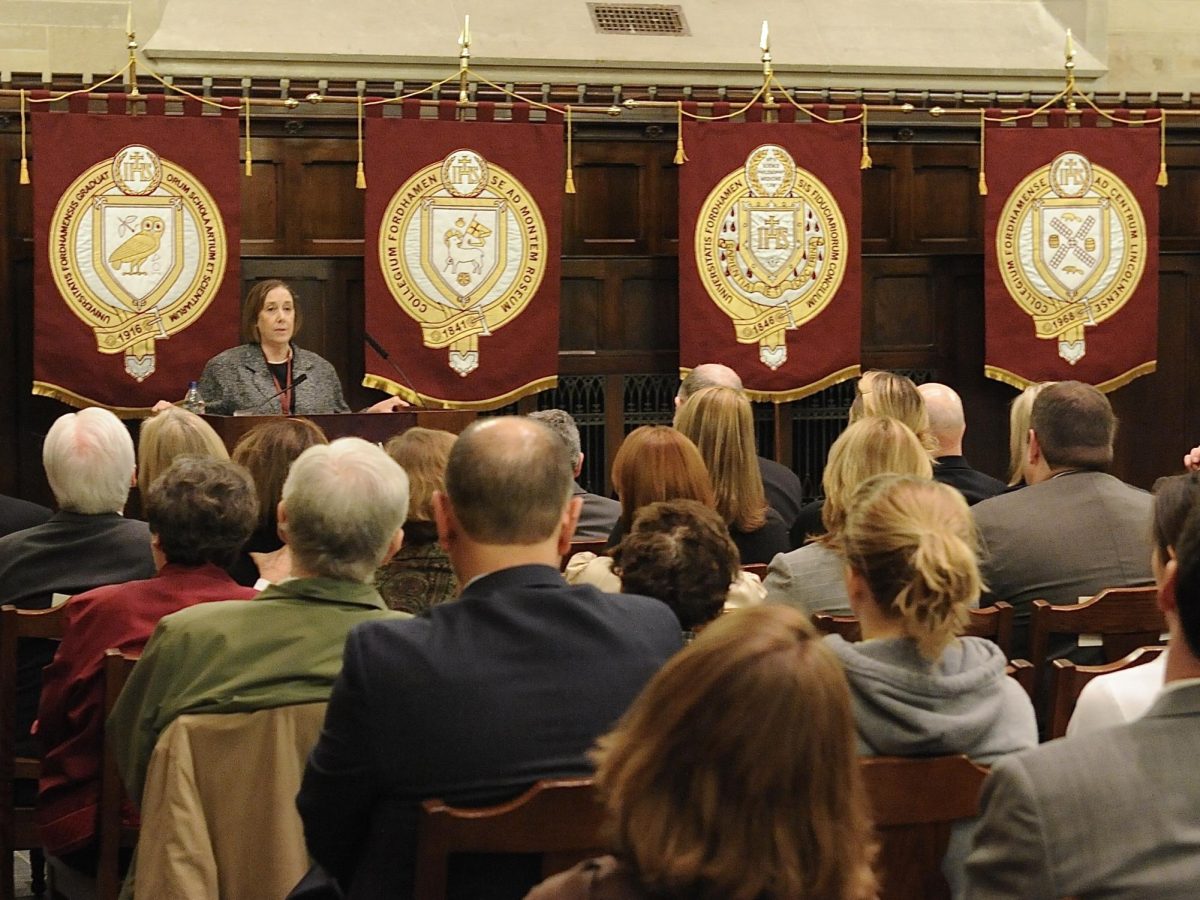

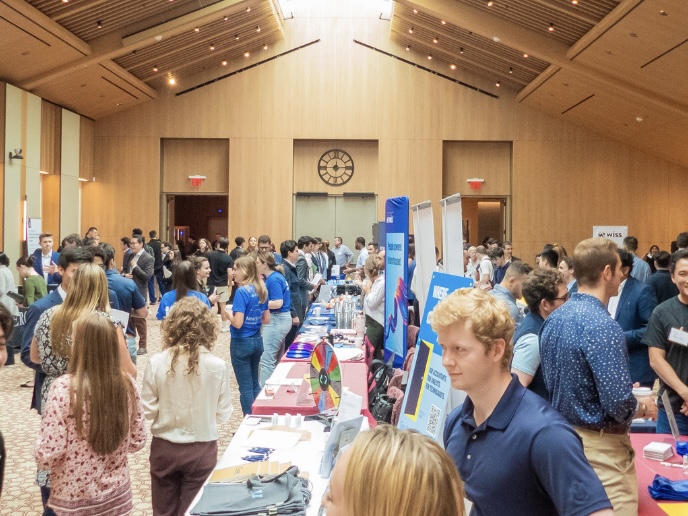

















































































































































































The Fordham University’s United Student Government (USG) held a State of the Students Town Hall on March 20 to discuss their ongoing contraceptive policy proposal. Other USG commissions and committees also tabled at the event to garner student support for their respective ongoing initiatives and proposals.
The event began with an introduction from USG Executive President Lucas Hjertberg, FCRH ’26, who read an excerpt from a 1967 editorial from The Ram explaining the long-standing discourses surrounding the contraceptive distribution on the Fordham campus. He continued by previewing the event and explaining why USG hosted it.
“The intention to gathering here today is not just to show the administration, ‘Hey, we have a lot of support for this one,’ but when students really care about an issue, no matter where they fall on it, that they deserve to be listened to, and that they can mobilize when the time is necessary,” Hjertberg said.
USG’s Contraceptive Policy Commission — which includes Vice President of Committee on Sexual Misconduct Aidan Costella, FCRH ’27, Senator Henry Carstens, GSB ’29, Senator Audrey Shooner, FCRH ’28, Senator Domenick Fedele, FCRH ’29 and Senator Anna Wiss, FCRH ’26 — then gave a presentation on what their proposal entails.
The proposal calls for the amendment of Fordham’s policy with on-campus contraceptive distribution, which currently prohibits the distribution of contraceptives “on Fordham University property, using University resources, and at University-sponsored events,” according to university policy. USG’s commission wants to change the wording to omit the language that bans their distribution while on university property. At the event, Carstens explained that the goal of their proposal is to restore students’ autonomy.
“While retaining the university resources and university-sponsored events, we believe that this [amendment] does not demonstrate that Fordham is endorsing the change, but rather returning the autonomy to the students,” Carstens said.
Carstens also emphasized that their proposed policy amendment does not ask Fordham to fund contraceptives and does not intend to elicit the university’s endorsement.
“We are not asking for Fordham to provide contraceptive resources. We are not asking for Fordham to fund contraceptive resources and we are not asking Fordham to endorse the use of contraceptive resources,” Carstens said. “What we are asking for is for an amendment that allows students to independently manage and distribute their own resources. We believe we should give the power back to the students to decide, as many other Jesuit universities do.”
The commission members also noted that sexually transmitted diseases (STDs) and sexually transmitted infections (STIs) disproportionately affect some of Fordham’s student demographic groups.
“USG also wants to recognize that this issue does not affect all Fordham students equally,” Costella said. “It has a greater impact on low-income and LGBTQ+ students. In addition, it affects students who have not received proper comprehensive sexual education before coming to Fordham.”
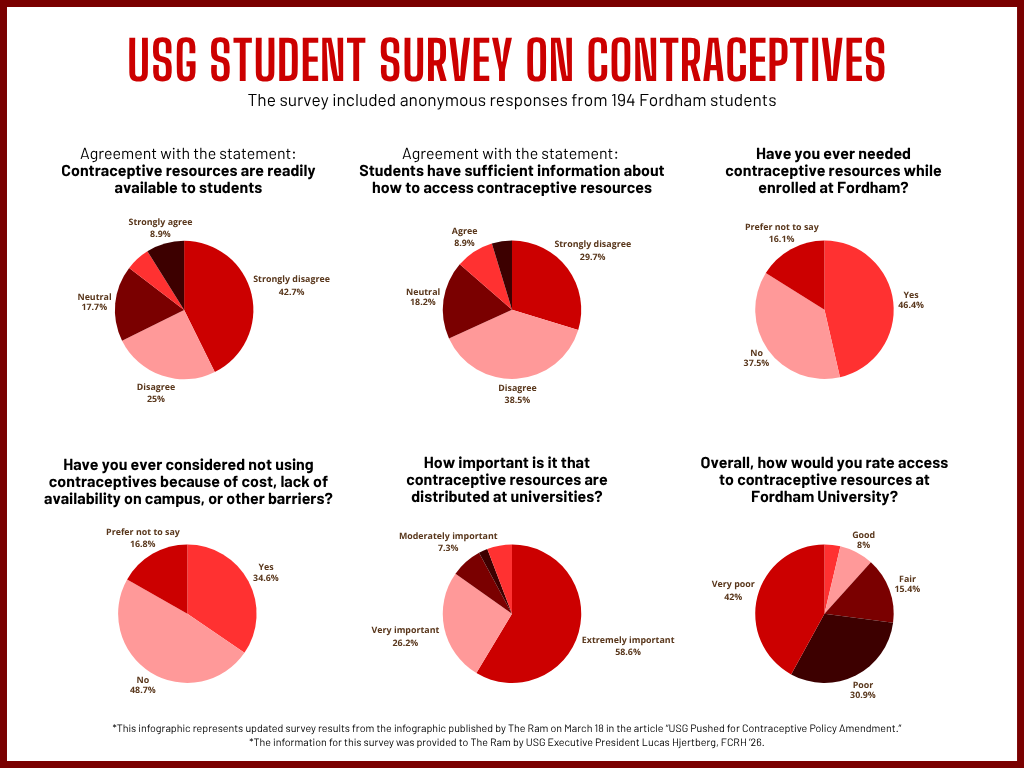
The USG presentation also included updated results from the recent USG student survey conducted to assess student support for their proposal and their opinions on the accessibility of contraceptives on campus. The USG survey received 194 responses and indicated overall support for USG’s proposal, with 92% of respondents saying that it is moderately, very or extremely important for contraceptive resources to be distributed on college campuses.
After the USG presentation, Fedele presented an endorsement on behalf of Professor Cristina Traina, Avery Cardinal Dulles, S.J., chair under the Catholic theology department at Fordham University. In her letter to USG, Traina outlined four reasons arguing why she would be endorsing this proposal.
The first point was on the fact that other Jesuit institutions allow for the student-to-student distribution of contraceptives. The second point regarded the moral argument of preserving the common good.
“In the past, Catholic institutions refused to endorse or provide needle exchanges for people who use injectable drugs because doing so publicly, scandalously involve Catholics in facilitating or even encouraging sinful drug use,” Traina said. “Instead, many contemporary Catholics argue realistically that preserving the common good requires containing disease … The moral primacy of institutional purity has given way to the moral primacy of the common good, which is in line with Catholic principles of social justice. The same logic applies to contraceptives and student sexual health.”
Her third point applied the idea of freedom of conscience to sexual relations and sexual health matters.
“Over sixty years ago, Dignitatis Humanae endorsed universal freedom of religion and conscience. Methodists, for example, consider sexual relations a matter of private consent and safe, contraceptive sex a moral requirement of ethical sex,” Traina said. “Fordham should not make it more difficult for these students to fulfill their religious conscience obligations.”
Her final point concerned compliance-based ethics versus the ethics of virtue, citing both Pope Francis and Pope Benedict XVI.
“Pope Benedict XVI even said that, in some circumstances, using a condom ‘in the intention of reducing the risk of infection’ can be ‘a first step in a movement toward a different way, a more human way’ of living our sexuality,” Traina said.
In her letter, Traina called upon the university to take more significant action regarding the handbook policy.
“I also suggest that the University remove language about contraception from its student handbook altogether,” Traina said.
Following the presentation of Traina’s support, several other student groups expressed their opinions about the policy amendment proposal, many of them also endorsing USG’s efforts.
Two members of Fordham’s College Democrats spoke first, endorsing the proposal and saying that USG isn’t asking much of the university.
“As it stands, the language in Fordham’s student handbook on this topic is incredibly outdated and constrictive,” Audra Morrison, FCRH ’29, shared for College Democrats. “We are not asking for anything radical or burdensome on the university’s part. We are simply asking for less infringement on our reproductive rights on campus.”
Next, the president of the Fordham Respect for Life club Abigail Adams, FCRH ’26, spoke on its behalf.
“I am confident that the on-campus distribution of contraceptives would weaken the university’s ability to live out its mission of cura personalis,” Adams said. “A Fordham that permits on-campus distribution of contraceptives is a Fordham without integrity.”
She went on to state that Fordham can’t “cherry-pick” the values it follows if it wants to truly be aligned with its Jesuit values.
“Catholic universities carry a particular responsibility to all values which they represent, even the controversial ones,” Adams said.
She also mentioned the possible side effects of some birth control as a reason why it should not be distributed to students.
“Physically, Plan B can cause headaches, upset stomach and can cause one to feel lightheaded. There is a mess of safety liabilities in allowing external groups to distribute pills, which women ingest into their bloodstreams,” Adams said.
Members of USG’s Committee on Sexual Misconduct and Adam Serfillipi, FCRH ’26, and Isabella Lipayon, FCRH ’26, both former editors-in-chief of The Paper, also spoke, all of whom gave their endorsement.
Global Markets President Jonathan Singh, GSB ’26, endorsed the proposal on behalf of the Fordham club. He said that all students on campus face the same concerns regarding things such as sexually transmitted infections and also sexually transmitted diseases, and all students should have access to resources.
“The students who [we] represent deserve to feel safe on this campus, not just financially safe, not just professionally prepared, but personally safe,” Singh said. “No student should have to fear … because a student representative isn’t allowed to help them. That’s a gap that doesn’t need to exist.”
Several members of Fordham’s unofficial unofficial chapter of Young Democratic Socialists of America (YDSA) club who have previously led efforts to distribute contraceptives off campus, spoke in support of the proposal.
“I’m here today to speak in support of this,” said YDSA President Matthew Smith, FCRH ’27. “However, I would like to go further and say that this is literally the absolute bare minimum. We are simply asking for the administration to remove a clause that prohibits organizations and students from distributing contraceptives.”
Other students who offered their opinions, also endorsing the proposal, included Raine Rodriguez, FCRH ’28, Jenna Cain, FCRH ’27 and USG Vice President of Facilities and Dining Madeline Ando, FCRH ’27.
Carstens and Hjertberg ended the event by thanking everyone for coming and encouraging attendees to visit the tables at the back of the room, other USG’s committees who were gathered support for their respective initiatives and proposals.