































































































































































Fordham University’s acceptance rate has declined by 11% for the class of 2030, from 58% to 47%, according to an article from Fordham Now. The article also reported a 23% increase in applicants from the previous year, bringing the total number to over 54,000.
This acceptance rate decline represents “a dramatic shift in selectivity over last year,” according to Fordham Now.
The average grade point average (GPA) among admitted seniors for the class of 2030 was 3.77, compared to the admitted senior GPA for the class of 2028, which was 3.78. Fordham remained test-optional this cycle, and year-over-year for the fall 2024 application cycle for the class of 2029, there was a 6.2% decrease in students admitted without test scores, falling from 66.2% to 60%.
Vice President of Enrollment Strategy explained what these statistics mean for people’s perception of Fordham.
“While we are becoming more selective in a statistical sense, our goal isn’t exclusivity for its own sake,” Gratale said in an email to The Ram. “The ‘admitted class’ profile — with an average GPA of 3.77 — shows that we are attracting some of the most talented students, and that naturally raises the bar.”
Gratale also said what factors he believes led to the increase in applications and decrease in acceptance rate.
“I believe this is driven by a ‘perfect storm’ of factors: our location in a thriving NYC, our commitment to Jesuit values that resonate with students who want to be changemakers, a sharpened brand identity that more accurately depicts Fordham’s distinction, and the relentless ground-work the admissions team has done over the last year to grow consideration among prospective students using high-touch experiences,” Gratale said. “College students are increasingly looking for an education that offers both rigor and purpose, and they are finding that here at Fordham.”
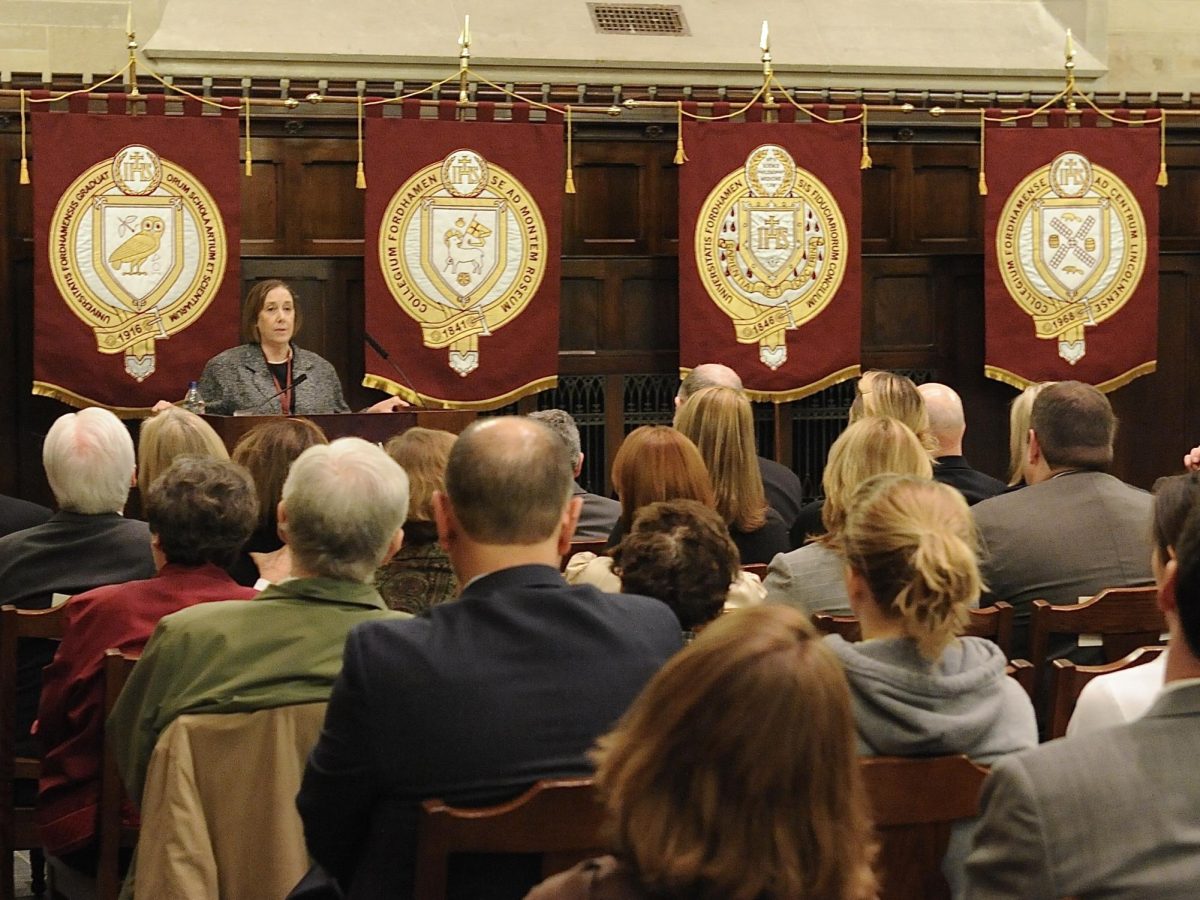
According to administrators, this shift reflects broader, long-standing efforts by the university’s administration and admissions department to bring down the acceptance rate. The Ram, along with The Observer, attended a press conference with university President Tania Tetlow in Oct. 2025 in which she spoke about the recent statistics and explained that the administration was focused on lowering the admissions rate because of its impact on student’s college decisions.
In a recent press conference that Tetlow held with The Ram and The Observer, she attributed the lowered acceptance rate and increased application to the university’s recent rebranding.
“I am so proud of our marketing and communications team,” Tetlow said. “They’ve done brilliant work that’s gotten national news coverage on its own with the quality of the work.”
Vice President of Marketing and Communications Justin Bell explained some of the work his department did that helped Fordham become more nationally recognized.
“Through marketing, communications, events, and experiences, we help in fostering relationships between Fordham and prospective students, which in turn grows interest and applications to ultimately land strong incoming classes,” Bell said in an email to The Ram. “Over the last year, our teams (Admissions and University Marketing and Communications) have collectively overhauled nearly every touchpoint throughout the recruitment journey to integrate our new brand identity, including webpages, email marketing, printed collateral, the college fair experience, and more.”
Dean of Admissions Patricia Peek also spoke on how Fordham’s rebrand helped change its admissions statistics.
“Building on the launch of Fordham’s evolved brand, we have been collaborating on new ways to get our Fordham message out to prospective students, which is resonating with both students and families,” she said in an email. “Institutions utilizing the Common Application averaged a 5% increase in applications compared to the same point last year. Our increase was significantly higher — 23% as of now.”
One factor playing into the acceptance rate decline is the use of Common App when applying to colleges, which makes the college application process easier, according to Peek. Through the accessibility of this centralized application option, the acceptance rate can increase not because fewer students are admitted, but rather because there are many more applicants.
Peek and Tetlow also discussed the phenomenon of the enrollment cliff, a birth rate decrease resulting from the 2008 economic recession that was said to start impacting higher education institutions this year, creating uncertainty for application numbers.
“We have been speaking about the ‘enrollment cliff’ data for about a decade. It is here,” Peek said.
Tetlow also explained that Fordham’s increased application rate and decreased acceptance rate represent success in this year’s admissions cycle despite the enrollment cliff.
“I am extremely excited about the statistics. They are even more dramatic, considering that in the higher ed marketplace, this is the year of the enrollment cliff we’ve been talking about forever, when there are fewer college-age students demographically, because 18 years ago was 2008 in the recession, and the birth rate dropped. So we’ve been sort of waiting for this moment to hit,” Tetlow said at the recent press conference.
Tetlow also said that marketing strategy was part of the university’s efforts to counter the projected decline in college applicants.
“This was definitely a time when it mattered that we not only invest in what makes Fordham special, but we tell that story better,” Tetlow said.
Despite the administration’s position that the rebranding was a success due to the resulting admissions statistics, many students had mixed reactions about the university’s efforts to decrease the acceptance rate. Katerina Kleinschmidt, FCRH ’27, expressed concern about Fordham’s priorities but also acknowledged the value in being more selective.
“It feels like Fordham is taking shortcuts to improve the school’s outer-facing reputation without taking the substantive, internal strides to improve our education,” Kleinschmidt said. “With that being said, there is value in comprising your student body of high-performing, motivated individuals.”
Other students were more positive about what the recent admissions statistics entail for the university. Cecelia Lewin, FCRH ’27, noted that a lower acceptance rate could benefit Fordham.
“Lower acceptance rates usually align with people’s perspectives of it being a ‘better’ school. Exclusivity equals desirability,” Lewin said. “I think honestly there was just a surge in applications … The change in [the] logo brought a lot of publicity.”
Jennifer Petra, university spokesperson, was not available for comment.