














































































































































































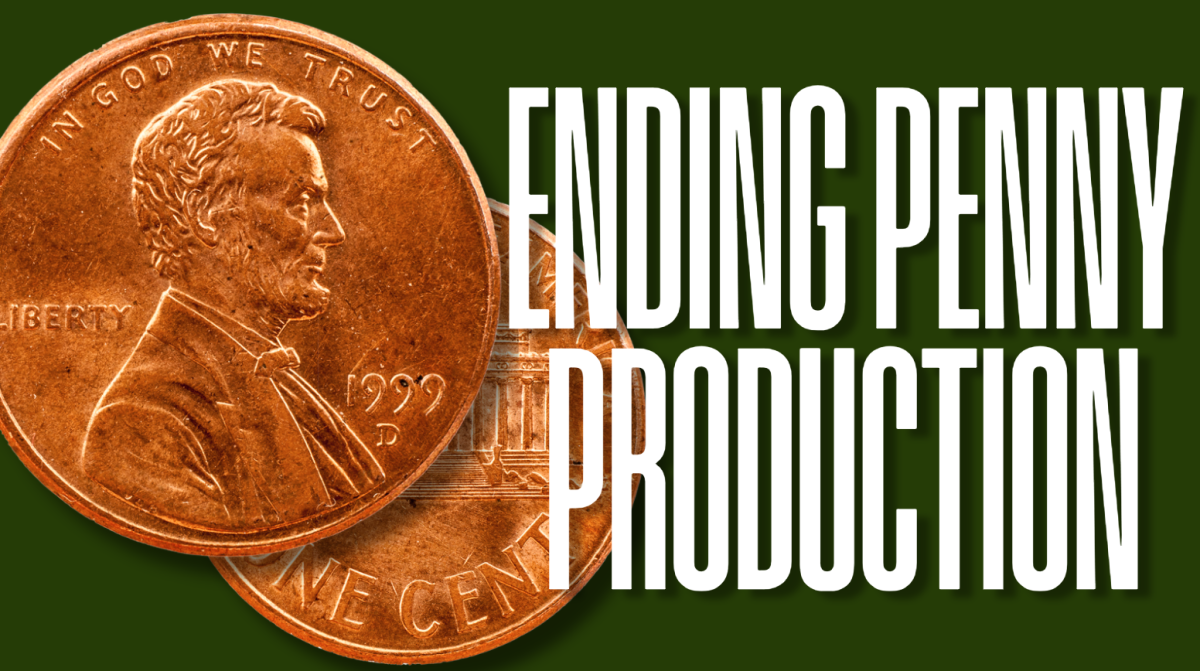
Our national penny has been looking at us since 1792, originally bearing the face of Lady Liberty before the switch to President Abraham Lincoln in 1909. Who in the world are we going to look up to now that the U.S. penny has been discontinued?
On Wednesday, Nov. 12, the United States Mint in Philadelphia pressed the last penny. The last coin to be discontinued was the half cent in 1857. So, how did we even get to this point?
President Donald Trump ordered the end of penny production after costs climbed to four cents per penny produced. Just before minting the final penny, U.S. Treasury Secretary Brandon Beach said, “God bless America, and we’re going to save the taxpayers $56 million.”
The 4.5 billion pennies made in the Fiscal Year 2023 cost taxpayers more than $179 million. Trump justified his decision to end penny production by citing its high production cost-to-value ratio and its shrinking purchasing power. Back in February, Trump said in a Truth Social post, “For far too long the United States has minted pennies which literally cost us more than 2 cents. This is so wasteful!” In the 2024 fiscal year, The U.S. Mint reported a loss of $83.5 million on the nearly 3.2 billion pennies it produced. This loss is largely due to the fact that one penny cost 3.69 cents to make in the 2024 fiscal year. That’s almost four times its own worth!
Such an abrupt cancellation has caused a shortage of pennies for some retailers. Many stores are now rounding up or down to the nearest nickel. Retailers are lobbying Congress to pass a law allowing all stores across the nation to round to the nearest nickel, given that at least 10 states have laws that ban rounding cash transactions up or down. The 250 billion pennies still in circulation remain legal, but many coin deposit terminals no longer accept pennies, exacerbating the issue.
Many bills have been introduced in Congress to alter penny production, including efforts to temporarily suspend the penny’s production, eliminate it from circulation or even require that prices be rounded to the nearest five cents. Any of these changes would lead to cost savings and speedier checkouts, as demonstrated by other countries that have already eliminated their one-cent coins. For instance, in 2012, Canada stopped minting its lowest denomination coin.
Former U.S. Representatives Jim Kolbe of Arizona and James Hayes of Louisiana were the first to formally suggest eliminating the penny by introducing the Price Rounding Act of 1989. Unfortunately, that bill was not passed. Sheridan said, “I also expect more and more businesses to move to a cashless model in the next 10 years … this would negate the need for businesses to round transactions to the nearest nickel.”
The Trump administration’s efforts to get rid of the penny started with the now-defunct Department of Government Efficiency and its goal to cut $2 trillion from the federal budget. “Let’s rip the waste out of our great nation’s budget, even if it’s a penny at a time,” Trump wrote in his post. But, what message does this send to those who still value the penny?
The penny has held significant meaning to America for over 200 years. The first pennies, issued in 1792, feature an image of a woman representing liberty. In 1909, in honor of Lincoln’s 100th birthday, he became the face of the penny. “We put mottos on them and self-identifiers, and we decide — in the case of the United States — which dead persons are most important to us and should be commemorated,” Fran Holt, an emeritus professor at the University of Houston studying history of coins, said. “They reflect our politics, our religion, our art, our sense of ourselves, our ideals, our aspirations.”
I do not use cash or change very often; I use credit or debit everywhere I go. It’s just an easier lifestyle, so this won’t impact me as much as it might for those who cherish the penny’s long history. Depending on their condition, any 1943 Lincoln wheat pennies still circulating could be worth over $100,000.
So, before you throw away your loose change, give them a closer look; you might find a rare one. You could win yourself a nice monetary prize at the bank or exchange kiosk. Spend and collect those pennies before it’s too late!
Bridgette Leahy, FCRH ’27, is a journalism major from Basking Ridge, New Jersey.
