
































































































































































































Imperialism is a very well-known word within academic and political circles, however, some can’t really define what it means. Imperialism is a policy of expanding a country’s force or dominance through diplomatic or military means. Over the past 132 years, especially since the end of the Second World War, the United States moved from a marginal imperial power in the western hemisphere to a world imperial power countering the Soviet Union. While U.S. leaders often said that this policy was about the containment of communism, government documents, such as NSC 68, say this is about maintaining global dominance. The overall sentiment of U.S. foreign policy seems to contradict what comes out of the mouths of U.S. leaders. That mindset of dominance brings us to exactly where the U.S. currently sits. As it relates to Iran currently, the U.S. could be echoing earlier chapters of. foreign policy.
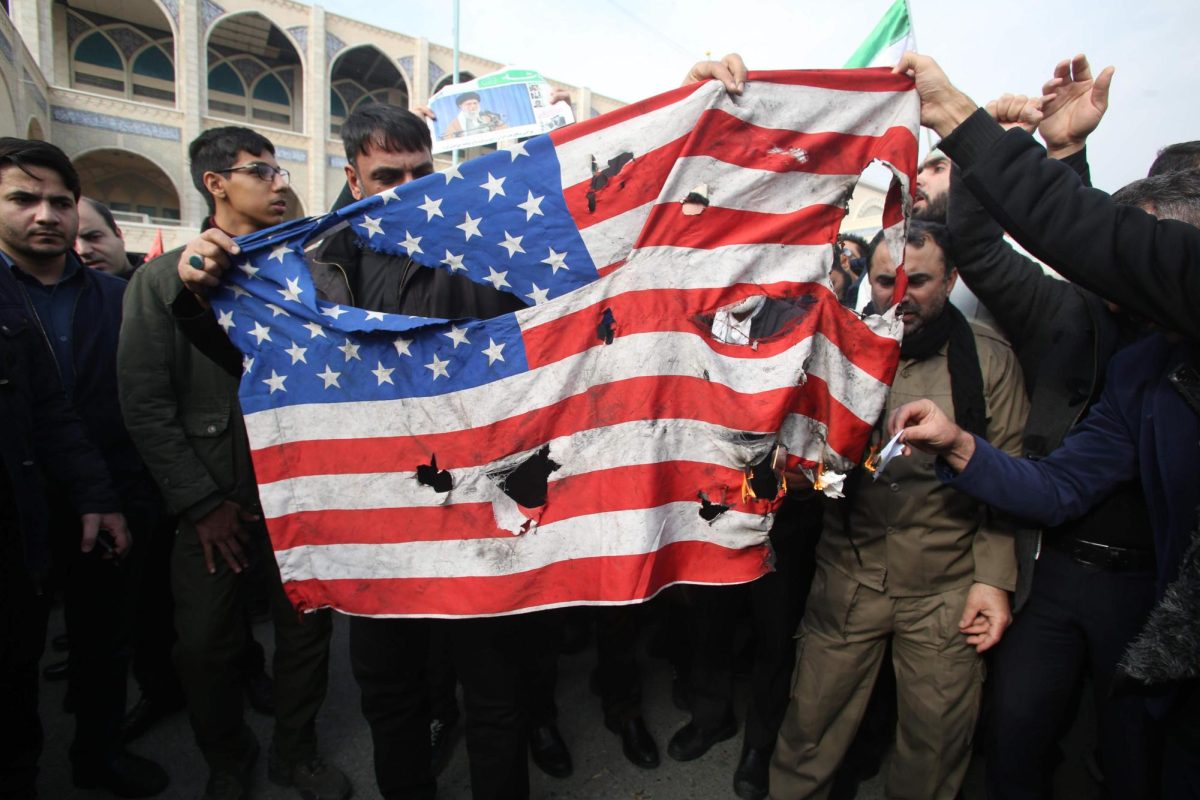
On Feb. 28, the U.S., in collaboration with Israel, launched a joint strike on Iran that killed the grand Ayatollah Ali Khamenei, along with about 1,300 citizens of Iran. The U.S. and Israel have ultimately said this is intended to wipe out Iran’s nuclear capabilities, but this falls apart under minimal scrutiny. Many Iranian officials, including their foreign minister Abbas Araghchi, said that Iran doesn’t plan to build a nuclear weapon. Additionally, Iran formally agreed to a deal the U.S. helped facilitate in 2015, but eventually withdrew in 2018. This set the stage for inflamed tensions with the U.S. that were somewhat easing with this agreement. Furthermore, Prime Minister of Israel Benjamin Netanyahu has claimed many times that Iran is close to building a nuclear weapon. Let us now move into the implications of these words.
These claims have been implied before justifying invasions and overseas operations. In 2003, prior to the invasion of Iraq, the Bush administration said Saddam Hussein had weapons of mass destruction for about two years before the U.S. ultimately invaded. The Obama administration said it was a humanitarian effort to invade Libya before the operation took place in March 2011. Despite the intentions the Obama administration had put forward, it ultimately led to a power vacuum forming once Gaddafi was overthrown. With instability increasing, rebel forces eventually took over and created open slave markets.
To provide another historic example, Operation Mongoose was enhanced by John F. Kennedy in October 1962 to overthrow Fidel Castro after the failed Bay of Pigs invasion. Although Cuba posed no threat after Castro ultimately overthrew Fulgencio Batista in the 1959 Cuban Revolution, the U.S. tried everything in their power to overthrow him. Their stated objective was to overthrow the communist regime of Castro and do it alongside Cuban rebel forces. While these examples are crucial in understanding U.S. geopolitical decisions, this is how they currently connect to present day warfare in Iran.
Although Iran has stated many times that they do not possess a nuclear weapon, nor do they want to, the U.S. and Israel have continued to disregard Iran’s word. It’s possible they do because Iran is a regional adversary to Israel. If Israel and the U.S. are successful in this war against Iran, Israel could move in on their greater Israel project they want complete.
As a prominent U.S. ally within the region, there are two things this could mean for the United States. It could mean that Israel could transform into a regional superpower and make the U.S. more influential within the region, or it could create more resentment and blowback against U.S. foreign policy decisions within the Middle East. White House Official Jarrod Agen has said, “the administration plans to get the oil out the hands of terrorists”. As I see it, it’s a repeat of what happened earlier this year with Venezuela.
The significance of these actions, both historically and currently, has serious implications for the American reputation and the American people. Although the Trump administration has explicitly stated that they want to revive the Monroe Doctrine, there are three different historical doctrines in play with current U.S. foreign policy under the Trump administration. The first is Monroe-era style determent from the western hemisphere assuring U.S. domination, the second is Truman-era style containment of adversaries be it China or Russia as they both had ties to Venezuela and Iran and the third is Bush-era style preemptive war by attacking enemies and targets before they can mobilize. The current war in Iran could have deadly consequences (as has already turned out to be), but it would be another chapter of U.S. foreign policy asserting dominance over the globe regardless of whether the administration is Republican or Democrat.
The offensive attack on Iran is not an isolated incident, but rather a continuation of historic U.S. foreign policy precedents that have been happening since the U.S. overthrow of the Hawaiian Kingdom in 1893. Although the Trump administration alleges the justification of preventing Iran from getting a nuclear weapon, we see that Iran clearly had no plans to. The only bigger question that follows is: What happens next now that Iran is fighting back?
Ethan Bess, FCRH ’27, is a media and television major from Roanoke, Texas.