

























































































































































































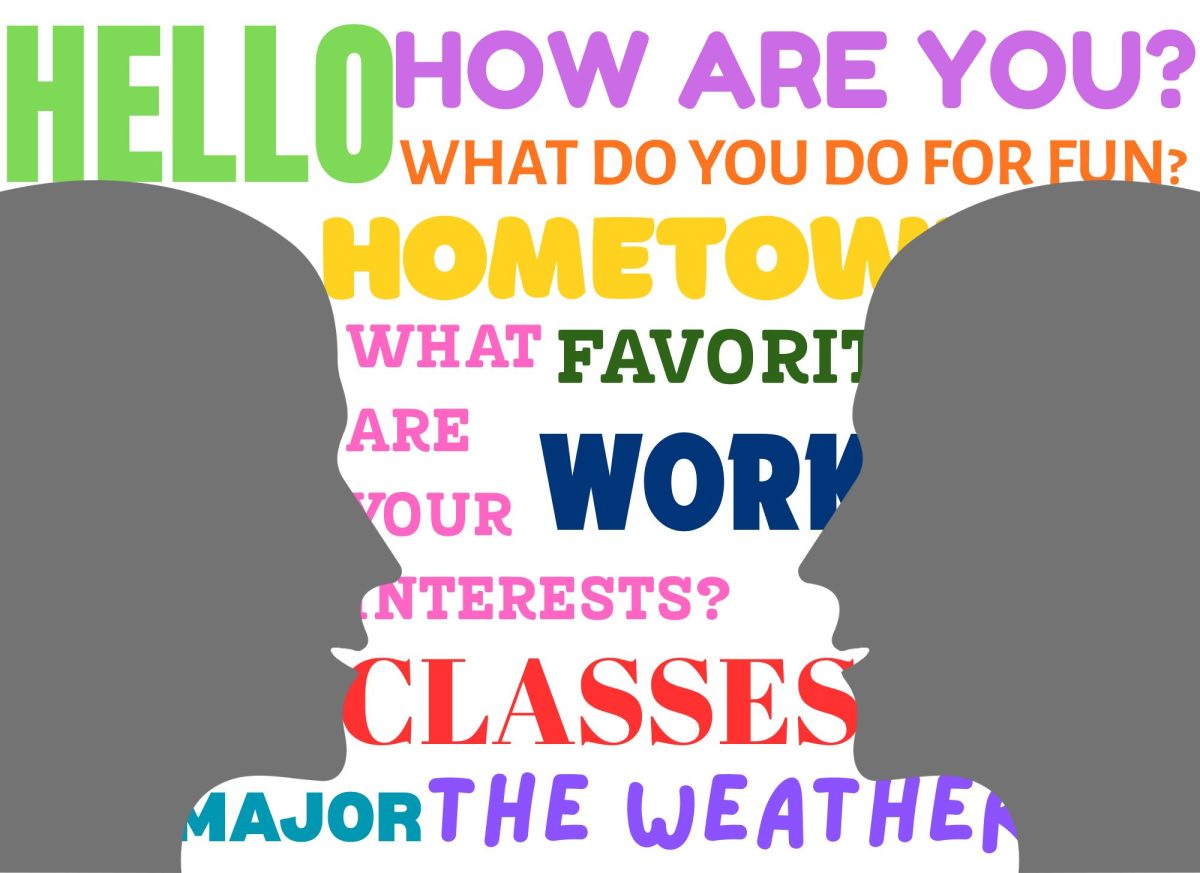
As an introvert, I despise small talk. It feels like the social equivalent of elevator music: mildly annoying but expected. I find the ritual exhausting, and as someone whose mouth often works faster than their brain, it doesn’t work out well for me. I can never come up with adequate answers and end up making a fool of myself. But as much as it sucks, it’s still a necessary part of our communication skills.
Small talk feels performative to me. People recycle the same phrases until the exchange becomes rehearsed and impersonal. We get rewarded for surface-level answers, and it often seems like the person asking doesn’t really care — so we learn to hide our responses behind polite, empty ones. It also demands a kind of instant sociability that not everyone is capable of doing. Not everyone (myself included) can be cheerful on command, especially at 8 a.m. on a Tuesday when we’re running on nothing but caffeine and stress.
There’s also the pressure of timing. Small talk usually happens in passing — in hallways, before class starts or while waiting for a professor to arrive. You have around 10 seconds to come up with something that sounds normal and friendly, and for people who overthink everything, that can be a tall order. By the time I’ve thought of a decent response, the moment has usually passed, and I’m left replaying the interaction in my head like a bad movie trailer.
Because of all this, I often dismiss small talk as a meaningless way to pass the time. But it actually serves as a “social safety check.” It allows us to gauge someone’s mood, establish basic trust and create a shared context. Those quick exchanges about our weekend plans or class assignments can reveal more than we expect if we’re willing to push past the awkwardness. After all, we’ve spent most of our lives in school, constantly crossing paths with classmates and professors. In those moments, small talk acts as the social glue that keeps interactions civil and predictable. It’s a low-cost way to show respect and keep the social machinery running smoothly — even if the conversation itself isn’t.
I may complain, but it’s impossible to deny that small talk is a gateway to meaningful connections. Some of my closest friendships have started with a throwaway comment about the weather, a shared complaint about homework or a random observation about something happening in our environment. Small talk is like knocking on a door — you never know what’s behind it until it opens. People who skip out on this ritual entirely risk missing these opportunities. In that sense, small talk is a social investment — tedious in the short term but potentially rewarding in the long term.
Another thing I’ve come to realize is that small talk isn’t just about the words themselves. It’s about signaling something: “I see you,” “I acknowledge you” and “I’m open to interacting with you.” It’s a tiny gesture of goodwill, even if clichés disguise it. In a world where people often feel isolated or overlooked, that gesture matters more than we think. A simple “How’s your day going?” can be the difference between someone feeling invisible and feeling noticed.
So how do we reconcile with this dislike? For me, the answer is to be intentional. I treat small talk as a tool instead of a performance. Rather than relying on a script of noncommittal answers, I stay honest. Authenticity keeps the encounter real and often invites the other person to be more genuine too. If I think of small talk as a skill rather than a social test, it becomes easier to practice active listening, notice others and build social capital.
It also helps to reframe what success looks like. Small talk doesn’t always have to be incredibly witty or profound. It doesn’t have to lead to a deep conversation; sometimes the goal is to acknowledge another human being and move on with your day. And if or when it does lead to something deeper, that relationship feels more natural because you’ve already built a small foundation of trust.
Small talk may never be my favorite thing, and I’ll probably always stumble over my words or overthink my responses, but I’ve stopped pretending it’s pointless. It’s a small, awkward bridge toward each other, and even if crossing it feels uncomfortable, it’s still a bridge worth crossing. In a time where everyone is busy, stressed and glued to their phones, these tiny moments of connection matter. They remind us that we’re part of a community, not just individuals rushing from one obligation to the next.
Catherine A. Payleitner, FCRH ’28, is a political science and journalism double major from Chicago, Illinois.

Jay Payleitner • Feb 11, 2026 at 7:26 pm
Catherine! I 100% agree—developing the skill of small talk can be a gateway to genuinely meaningful relationships. Taking it a step further, keep a few favorite questions in your toolbox and commit them to memory. Try a few self-deprecating, disarming openers like, “Let’s skip the weather—what’s something that made you smile this week?” or “I’ve had some ups and downs this week. I could use a win. How about you—any recent wins, big or small?” or “I’m on a new quest for local adventure—any recommendations? Parks, restaurants, stores, hobbies?”
Then, of course, the key is to listen. Get someone talking about their hopes, interests, and stories, and you just might walk away with a new friend for life.