








































































































































































The world is moving in the direction of depreciation, and the youth are done with it. Different societies across the world are protesting against their governments due to their incompetence. We’ve seen it in America with “No Kings” protests, we’ve seen it in France with the calling for the resignation of President Emmanuel Macron, in Indonesia with protests against the price of living, in Nepal with their revolt against their government and in protests for the liberation of the Palestinian people in Gaza.
The line that connects all of these is the apathy we’ve received from our government officials and, to put it frankly, their inhumane decisions. In America, we’ve been faced with the blunt end of that stick with the longest government shutdown in history, including the loss of Supplemental Nutritional Assistance Program (SNAP) benefits, and the staffing and funding cuts across critical federal agencies. We’re losing pieces of our infrastructure that enable us to have an operating economy and opportunities to better ourselves at the expense of the greed inherent in tax cuts that favor the wealthiest Americans.
So, what can Fordham do? I say the solution begins with shifting more towards the humanities. The teaching of humanities allows us to see beyond the framework of problem and solution, and more into the factors around these two terms and notice what conditions allowed both the problem and the solution to exist.
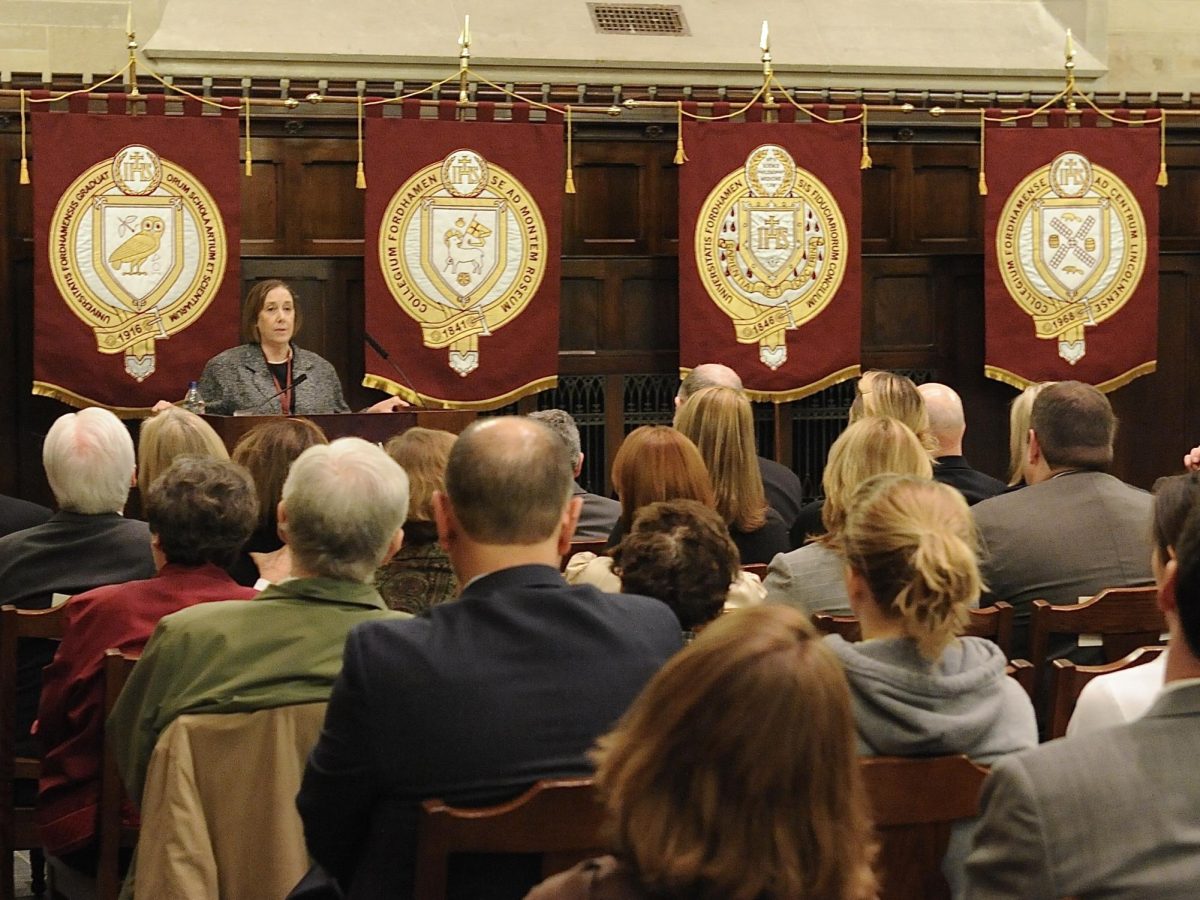
The humanities teach us how to learn and think. They allow us to be critical of the decisions we make and how to utilize the tools we create, most recently, Artificial Intelligence (AI). In September 2025, the school was given a $1 million donation for AI research by Peter Zangari, a Fordham alumni and a leader in financial markets. While this donation is meant for interdisciplinary AI research with an emphasis on finance, economics, asset management and data science, I found it appalling that a liberal arts institution accepted this donation with open arms. Fordham’s core values emphasize the liberal arts and the humanities as shown with our official university seal that reads “Arts, Science, Philosophy, Medicine, Law.” The direction this investment is taking the school in is stepping away from what it was founded upon and shouldn’t be taken so lightly. Shifting research focuses to artificial intelligence inadvertently makes the humanities weaker.
The humanities enables us to understand our own human nature. I get that almost no one ever wakes up and says, “I wanna go to Philosophy 1000 today!” However, while many may dread these classes, they allow us to understand our mode of thoughts and how to look at something and think critically about it. For instance, take the problem of world hunger. According to the United Nations, over 1 billion meals were wasted every day in 2022, while a third of humanity faced food insecurity. The world produces huge quantities of food but many people do not get enough to eat. Some may find it easy to dismiss the problem, saying that there is nothing that can be done about it or that people need to work harder. Humanities students, on the other hand, learn to ask critical questions about the more complex dimensions of the problem, getting to the root of why many people are food insecure. The difference between these two responses is what the humanities is all about: looking past the immediate problem, getting to the root of it and imagining new ways forward. Theology Professor Leo Guardado explains it like this: “The humanities teach you how to learn and think. They invite you to the human world that isn’t quantifiable. Without that, what does it mean to be human?”
When looking at the American job market, it’s always in flux. When people attack the humanities, it typically goes like this: “Who’s going to hire someone who studied something we don’t need! STEM is what pushes us forward.” To that I say, look at the majors who have the highest unemployment rate. Computer engineering has an unemployment rate of 7.5% and physics sits at 7.8%. The highest on that list is anthropology with 9.4%. Those stats are disheartening but it’s important to remember that you can still make it in an adjacent field if you’ve studied humanities since they all still tend to the core question of, “how do we be better humans?” Guardado said, “The humanities don’t shift as quickly. It’s not as volatile but not as many jobs [available] … It’s responsible to think about marketability and to not be trapped in the paradigm of what is viable to study and what is not.”
With the world constantly evolving, we’re living in an era of extreme potential change. Governments are being overthrown and we’re always walking into unprecedented times. With these questions looming, I truly believe it’s more important than ever to ask questions about ourselves than it is to uphold a system that will ultimately doom us all.
Gabriel Capellan, FCRH ’28, is a journalism major from the Bronx, New York.