























































































































On Feb. 26, New York City Mayor Zohran Mamdani returned to the White House for his second meeting with President Donald Trump. The encounter appeared more like a continuation of an unlikely political “bromance” than a tense negotiation between two men who spent the last year trading insults. But beneath the friendly optics, the meeting was driven by two urgent issues: a major affordable housing proposal in Queens and the same-day detention of a Columbia University student by federal immigration authorities. Mamdani raised concerns about the arrest and the student was released several hours later.
The long-stalled Sunnyside Yards project, which Mamdani is trying to revive with federal support, would create 12,000 housing units and 30,000 union jobs. During the meeting with Trump, Mamdani secured $21 billion in federal funding to move it forward.The meeting was described as cordial, productive and even friendly, which are not the words that most New Yorkers would have used to describe the relationship between the two men just a few months ago.
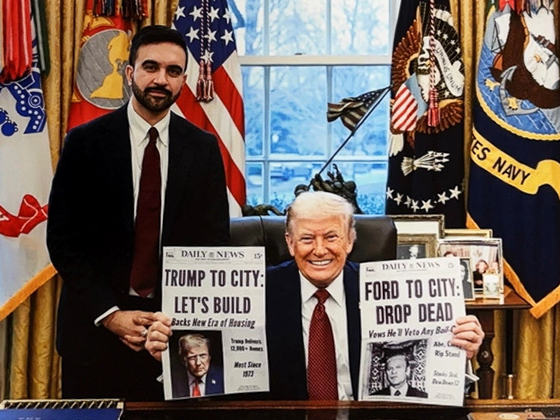
Last fall, when Mamdani was still mayor-elect, Trump labeled him “a communist,” which is a familiar insult from the man who once declared an entire Anti-Communism Week. Mamdani, for his part, used his victory speech to argue that defeating Trump required dismantling the conditions that allowed him to rise in the first place. Their agendas, constituencies and political vocabularies could not be more different. And yet, their second Oval Office meeting produced a smiling photo-op complete with props of a mock Daily News cover reading “TRUMP TO CITY: LET’S BUILD!” modeled after the infamous 1975 “FORD TO CITY: DROP DEAD!” headline. Trump reportedly loved it.
So what is going on here? How did two politicians who built their careers on polar opposite rhetoric end up in what seems like America’s strangest political bromance?
Political strategists have recently described both men as populist leaders of very different flavors. They appeal to different bases for different reasons, but each can command a fiercely loyal movement. When two politicians know that attacking each other won’t shake their supporters, the incentive to escalate the conflict weakens and the incentive to extract something useful from the other grows.
For Trump, it’s simple: He plays the role of dealmaker-in-chief, reinforcing his preferred image as a builder, negotiator and a man who can get things done for New York (a city that never fully embraced him). The Sunnyside Yard project, with its scale and symbolism, allows him to claim credit for a generational investment in housing and comes with more prestige than changing the name of a building.
For Mamdani, the calculus is more complicated, but no less strategic. He needs federal funds to build the kind of housing he campaigned for and he also needs to show that it is possible to stick to your values while still doing what it takes to get things done. If dangling a tabloid headline in front of Trump,like he’s a toddler in front of some keys is what unlocks billions of dollars for affordable housing, then the choice is clear. Mamdani understands that Trump responds to flattery, spectacle and media symbolism. So he uses those tools not to praise Trump’s politics, but to secure outcomes for New Yorkers.
His supporters elected him to deliver real change, not just symbolic statements. If he has to sit in a meeting with a president who has mocked him multiple times to produce a positive outcome for his constituents, then Mamdani will do it. This is where the “bromance” begins to fall apart. Trump may genuinely enjoy the theatrics, but Mamdani’s posture is fundamentally different; Trump sees a partner where Mamdani sees an opportunity.
This also works because Trump is susceptible to flattery and symbolism. He responds to gestures that make him feel central, respected and indispensable. Mamdani’s team understands this better than many of Trump’s allies. The mock headline made Trump feel like the hero of the story while Mamdani secured the actual prize.
Both men are populists, but their populisms run on completely different fuel. Trump’s is grievance-driven and personality-centered; Mamdani’s is policy-driven and coalition-centered. When they sit in the same room, Trump gravitates towards the performance of partnership, while Mamdani focuses on the transaction beneath it. In the end, both men walk away satisfied, but for different reasons. Trump gets to tell a story about bipartisan cooperation that flatters his ego and Mamdani gets to tell one about governing that delivers for his constituents. One is symbolic, the other is substantive.
And that’s exactly why this isn’t a bromance. It’s a mismatch of motivators that is a single motivator. Trump thinks he’s gaining a friend and Mamdani knows he’s gaining leverage. The question now is whether Mamdani can keep the act up without giving Trump more than theatrics in return. The balance between strategy and spectacle will determine whether this odd political pairing remains useful, or whether Trump eventually realizes he’s not the one holding the keys.
Catherine A. Payleitner, FCRH ’28, is a journalism and political science double major from Chicago, Illinois.
