










































































































































































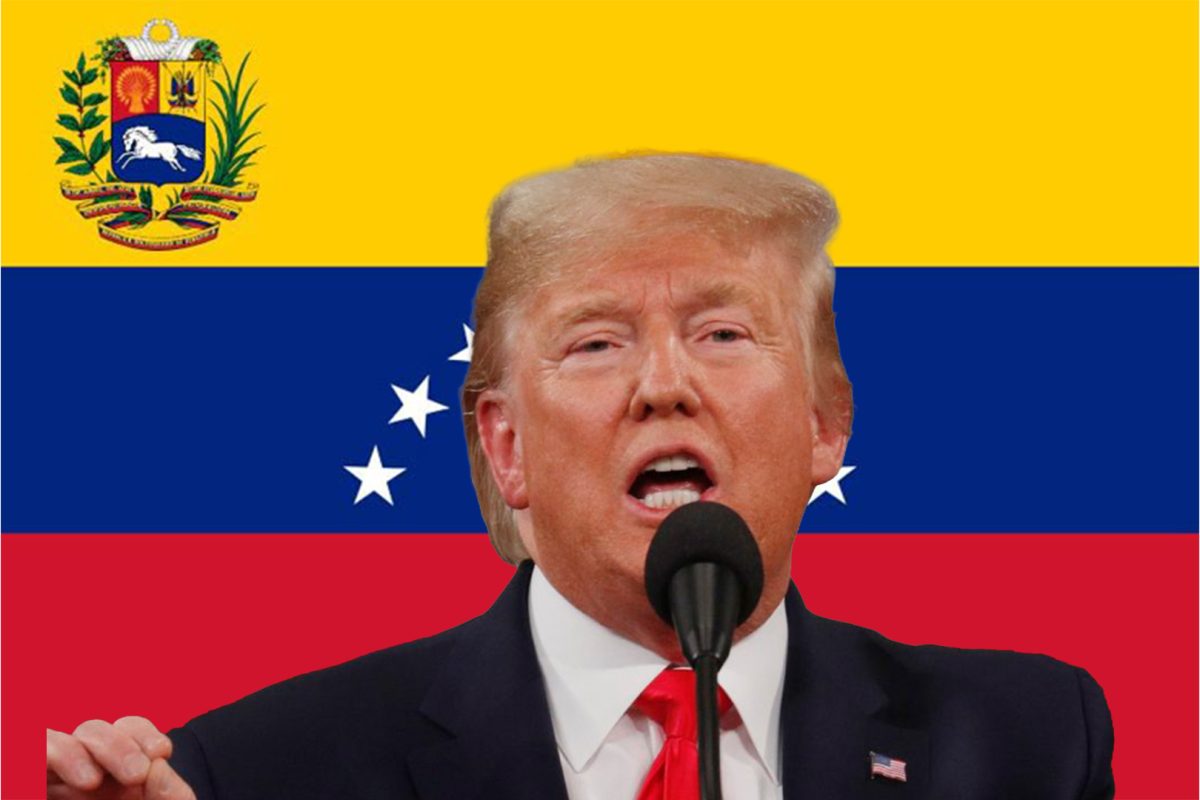
The second Trump administration has been beating the drums of war against Venezuela, and the American public is asked to believe the narrative that this is about protecting this country from drug smuggling and narco-terrorists. But many, including myself, have different thoughts and believe that this is disguised as a humanitarian act with the true goal of regime change.
In fact, Venezuela sits on top of approximately 303 billion gallons of oil reserves, making them the largest proven oil reserves on the planet. The current administration uses the justification that they are stopping the flow of narcotics from Venezuela, saying that substantial amounts of fentanyl enters the U.S. from Venezuela, but the paperwork and verified numbers tell a different story. The U.S. international narcotics control strategy report, posted in March 2025, says that Mexico, not Venezuela, is the primary source of fentanyl entering the United States and the DEA agrees with this assessment. In that same report, it’s discussed that less than 10% of all illicit drugs in the U.S. come from Venezuela, and the amount of cocaine imported is 0%.
As a matter of fact, if the U.S. was serious about stopping drug trafficking, they would look to the Pacific Ocean as opposed to the Caribbean. Mexico is a giant transfer zone of drugs into the United States. However, the Department of Justice’s maps show most flowing from Colombia into the Pacific. Nonetheless, one can see that this is a masked operation, just like one carried out in Iraq during 2003. It’s also necessary to acknowledge these similarities with respect to the 21st century, as the war in Iraq is the most controversial war that has occurred since the turn, so I believe it’s only right to compare it to this recent invasion..
The buildup to the Iraq war involved about two years of propaganda buildup by the Bush-Cheney administration around the idea that Saddam Hussien had weapons of mass destruction and ties to Al-Qaeda, which is the terrorist group that attacked the United States on 9/11. These claims later proved to be false and exaggerated as there was no credible evidence to support them, leading many Americans to think: “Was this war about natural resources and oil?” Their suspicions had merit as it was later reported by CNN that defense contractors such as KBR that Dick Cheney had ties to revealed that he made about $40 million from the Iraq war and the devastation that followed. The backlash proved to be consequential as some have argued that it broke the entire region and became a hotbed for terrorism at the expense of U.S. interventionism. With this context laid out, let’s now look at current day Venezuela.
The current Trump administration argues that the reason for waging this war in Venezuela is not for resources, but to stop the drug smuggling coming into the United States, referencing the theory that Nicolás Maduro is a drug lord and is the head of a major cartel by the name of Cartel de los Soles (Cartel of the Suns in Spanish). However, Cartel de los Soles is not a traditional drug cartel nor is there any substantial proof to say that it even exists. The U.S. government hasn’t brought forward any evidence to suggest that Maduro is linked to these cartel members, so one can assume it’s a way to manufacture consent for a bigger attack on Venezuela.
This can also be linked to the fishing boats being bombed off the coast of Venezuela. Many human rights activists and groups say that these strikes, which have occurred on more than 20 boats, are not only illegal under international law, but also under U.S. law. Framing them as “extrajudicial killings,” I might also add that under Article 2(4) of the U.N. charter, it forbids the threat or use of force against territorial integrity or political independence of a state unless that state is an imminent threat to the one exhibiting the force. Venezuela hasn’t posed an imminent threat, so there is merit to the argument that these strikes — under international law — are very much illegal. Especially the double tap that Pete Hegseth ordered after the first boat strike.
Operations in Iraq defined the 2000s and millennials’ lives due to their destructive nature, and Venezuela could define Gen Z and Gen Alpha in a similar manner considering the devastating implications for the U.S. globally. What one may be concerned about is not necessarily the Trump administration carrying out this war, but the continued pattern of U.S. foreign policy interests aligning on a purely economic or hegemonic scale.
There is, however, one area that seems the most merited but falls apart under minimal scrutiny, and that is that the U.S. is doing this to liberate the people of Venezuela from a brutal and tyrannical dictator. It’s a tough game to talk on paper, but the U.S. has a history of backing dictators when it comes to expanding U.S. interests. Not to mention, according to both Counterpunch and Truthout, The U.S. arms and supports around 75% of the world’s authoritarian regimes.
The reaction of an average American citizen of skepticism to the current operation near Venezuela is perfectly understandable. If the United States and the Trump administration are serious about curbing drug smuggling into the U.S., they should look to the Pacific and not the Caribbean, and certainly not commit war crimes like bombing fishing boats or even attempting regime change which, again, is illegal under international law. It’s also a driving factor as to why many members of the U.S. armed forces are seeking outside legal counsel, because even they are concerned that what they are being asked to do is completely illegal. The United States and the Trump administration must halt their efforts or face consequences, along with worldwide condemnation.
Ethan Bess, FCRH ’27, is a media and television major from Roanoke, Texas.


Deneen • Jan 28, 2026 at 2:53 pm
Great article Ethan. Another interesting point raised is where do the military go for Justice? Wow we support 75% of authoritarian governments!? Who can they call upon to advocate their stance against their own government? I see the likes of Nuremberg trials in America’s future. Truly, dWade
John Davenport • Jan 31, 2026 at 1:43 am
I agree wholeheartedly with this op-ed.
John Davenport
Professor of Philosophy