













































































































































































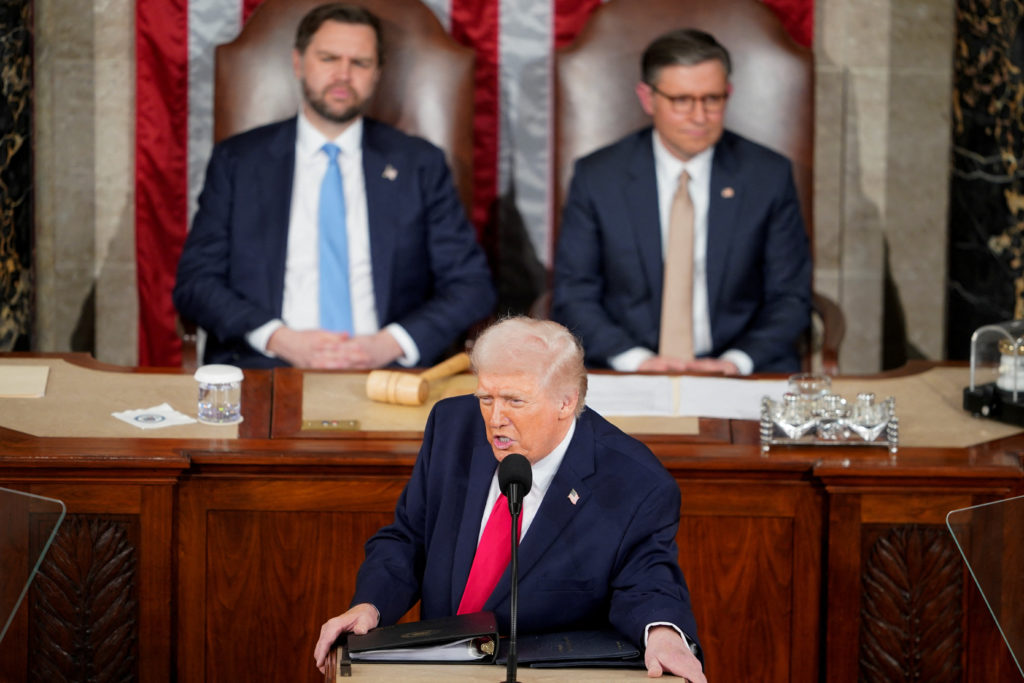
On Feb. 24, President Donald Trump delivered a record-breaking State of the Union address, lasting nearly two hours, the longest in the United States’ history. Painting a “nation in the early stages of a historic boom,” Trump presented a vision of a revitalized America that many Americans simply do not recognize in their daily lives.
The State of the Union historically is a formal communication from the president to Congress in order to report on the current condition of the U.S. while simultaneously providing policy proposals for the upcoming legislative year. In theory, it is a moment for honesty and direction: a president explaining where the country stands and where it should go next. Trump’s speech, however, felt less like a roadmap and more like a campaign rally stretched to two hours.
At the center of the address was Trump’s insistence that the American economy is booming and that his administration is rapidly ending the affordability crisis. “Our nation is back, bigger, better, richer and stronger than ever before,” he declared. He also blamed Democrats for raising prices in housing, healthcare, gasoline and everyday goods, claiming their policies “created the high prices.” But this explanation is far too simple and in this day and age, frankly politically convenient for Trump and the Republican party. Especially when, under his leadership, gas prices have recently jumped by about 10 cents a gallon in a single day, partly driven by rising tensions as the U.S. becomes further involved with conflicts in the Middle East.
The affordability crisis did not appear overnight, nor is it the product of just one party. Inflation surged globally following the pandemic due to supply chain disruptions, labor shortages and overall shifts in consumer demand. Housing costs have climbed for years due to limited supply and restrictive zoning policies across the country. Healthcare prices have been rising for decades under administrations of both parties. Blaming Democrats for every dollar Americans spend at the grocery store might make for an easy applause line for Trump, but it doesn’t bring him or the country any closer to real solutions.
If anything, some of Trump’s own policies complicate the picture. His aggressive use of tariffs -– intended to protect domestic industries -– can also raise costs for consumers by making imported goods more expensive. While tariffs may help certain sectors of the economy, they can also quietly push prices upward for everyday products, the very problem Trump claimed in this address that he is solving. To put it simply: Trump declaring victory over the affordability crisis does not mean us Americans truly feel it.
During his reign of everything from creating the Kennedy Center to building his own ballroom, Trump has been focusing on creating spectacle. Trump brought out the U.S. Men’s Hockey team during the address and awarded the Presidential Medal of Freedom to goalie Connor Hellebuyck. This follows him going viral on social media with the same team earlier that week due to not wanting to invite the additionally gold medal winning team, the U.S. female hockey team, to the White House. These moments were clearly designed to “energize” the room and generate viral headlines for those tuning in. This highlighted a broader trend in modern State of the Union addresses, while also showing how Trump’s government policy often takes a backseat to political theater.
More troubling, however, were the divisive elements of the speech. Trump renewed attacks on immigrants in the U.S., accusing “illegal aliens” of costing taxpayers billions without presenting any evidence. These remarks reinforce a political strategy Trump has created that frames entire communities and cultures as problems rather than participants in American life.
If the goal of the State of the Union is to unify the country, even if done briefly, this year did the opposite. Still, the most revealing part of Trump’s speech was his repeated claim that America is experiencing a national “revival,” and a “turnaround for the ages.” These are appealing phrases. Every president wants to convince Americans that the country is entering a new era of strength and prosperity. But offering revival whilst celebrating America’s 250th birthday raises the question: What exactly are we trying to bring back and accomplish?
Is it economic stability? For Americans to afford housing, healthcare and education without constant financial anxiety? Is it faith in democratic institutions and the rule of law? Or is it something else entirely — an era that is defined more by political loyalty than by shared values?
Trump’s version of revival seems largely rooted in political victory and cultural grievance. Yet the most important thing America should be focused on reviving should be defined by opportunity and holding the government accountable to work together to confront complex problems honestly.
While the U.S. is not on the brink of a total collapse, it is also certainly not experiencing the historic boom Trump described. Contrary to what Trump may have said during his address, Americans are still grappling with high costs, political polarization and uncertainty about the State of the Union as well as the future of the world.
A two-hour speech cannot solve these problems, but it should at least acknowledge them clearly. Instead, Trump offered a message built on confidence, blame, unnecessary applause and attention. For a country looking for serious solutions, after this speech, Trump is quickly becoming the biggest disconnect of all for the United States.
Kelly Buban, FCRH ’29, is a journalism major from Middlebury, Connecticut.


Marcie • Mar 22, 2026 at 9:09 am
Well done Kelly!
Cathy Guttentag • Mar 20, 2026 at 9:55 am
Absolutely right! Good accurate article.