








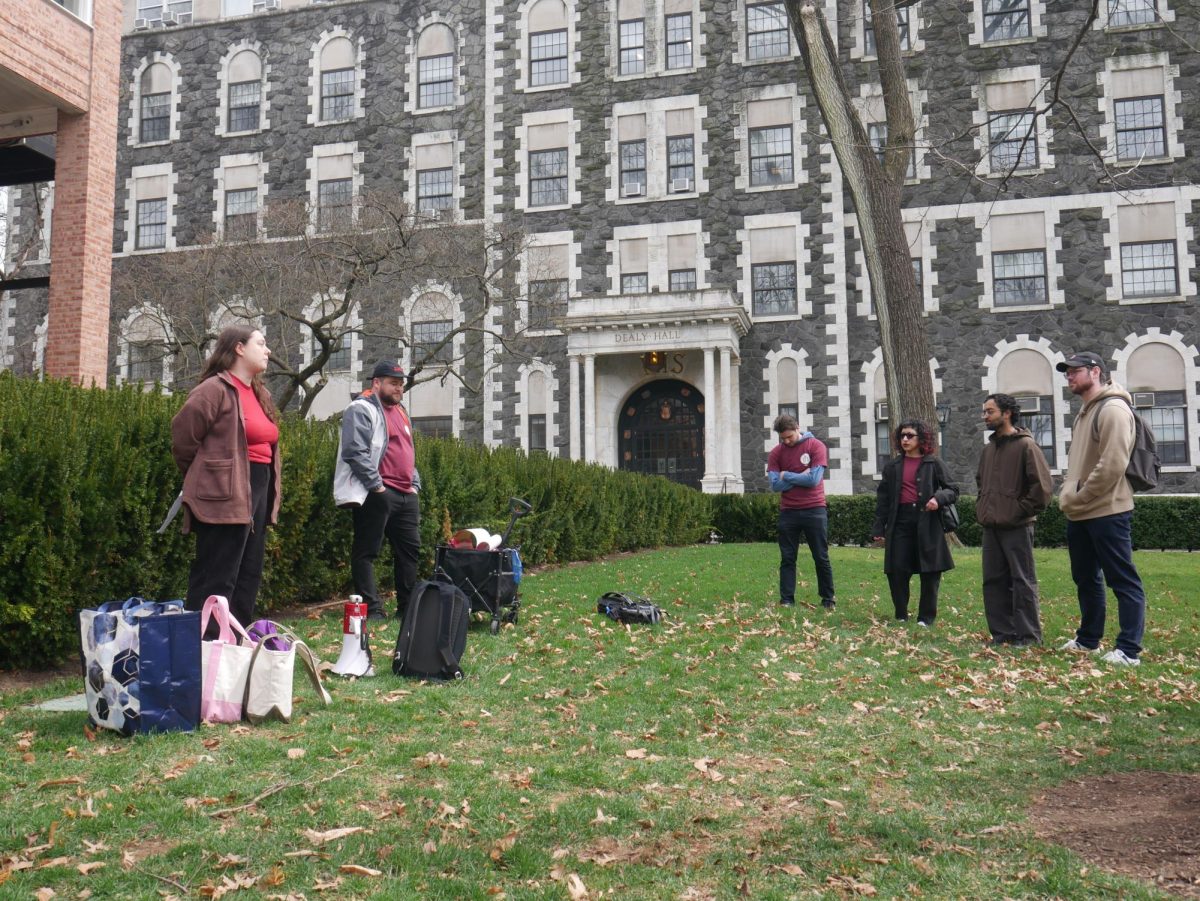




























































































































Fordham University faculty and students attended a protest against Marc Rowan and the Trump administration’s “Compact for Excellence in Higher Education” on Nov. 7.
The demonstration was organized by the American Federation of Teachers, American Association of University Professors (AAUP), National Education Association and Sunrise Movement. It was one of over 100 held around the country that day as part of a nationwide “Higher Education Day of Action” to push back against government intervention in higher education.
“Higher education is a public good. It’s good for democracy, it’s good for the economy. And so it’s worse for all of us if it gets controlled one way or the other from the outside,” said Tom Beaudoin, a professor of religion at Fordham and president of Fordham’s chapter of AAUP. “When higher education suffers from unjust incursions, the country suffers.”
The “Compact for Excellence in Higher Education” is a document that was sent to nine universities by the Trump administration on Oct. 1. It outlines a list of demands that the universities were asked to agree to in exchange for preferential federal funding.
Some of the demands outlined in the document include removing affirmative action from admissions decisions, abolishing practices that “purposefully punish, belittle, and even spark violence against conservative ideas,” reducing the international student population at universities, implementing preferential admissions for American students and more.
While seven of the universities have openly rejected the agreement, the University of Texas and Vanderbilt University have not yet made a decision, according to the New York Times.
Rowan is the co-founder, chief executive officer (CEO) and chair of the board of Apollo Global Management as well as chair of the board of advisors of the Wharton School of Business at the University of Pennsylvania. He helped author the document and has publicly served as a significant proponent of the compact.
In response to the compact, university professors, students and more organized to oppose the document and specifically to oppose Rowan’s influence in political affairs. Fordham’s chapter of AAUP sponsored the protest that took place in Manhattan and assembled a group of 15 faculty members to attend. Beaudoin explained why it is important to speak against Rowan’s role.
“We need to be free to pursue our research and our teachings. Students need to be free to learn … faculty and students need to be free to express ourselves on campus and off campus without penalties,” Beaudoin said. “So to push back against someone who is a major force behind these compacts, and to push back against the compacts, is to say, as the protests said, ‘Hands off higher education.’”
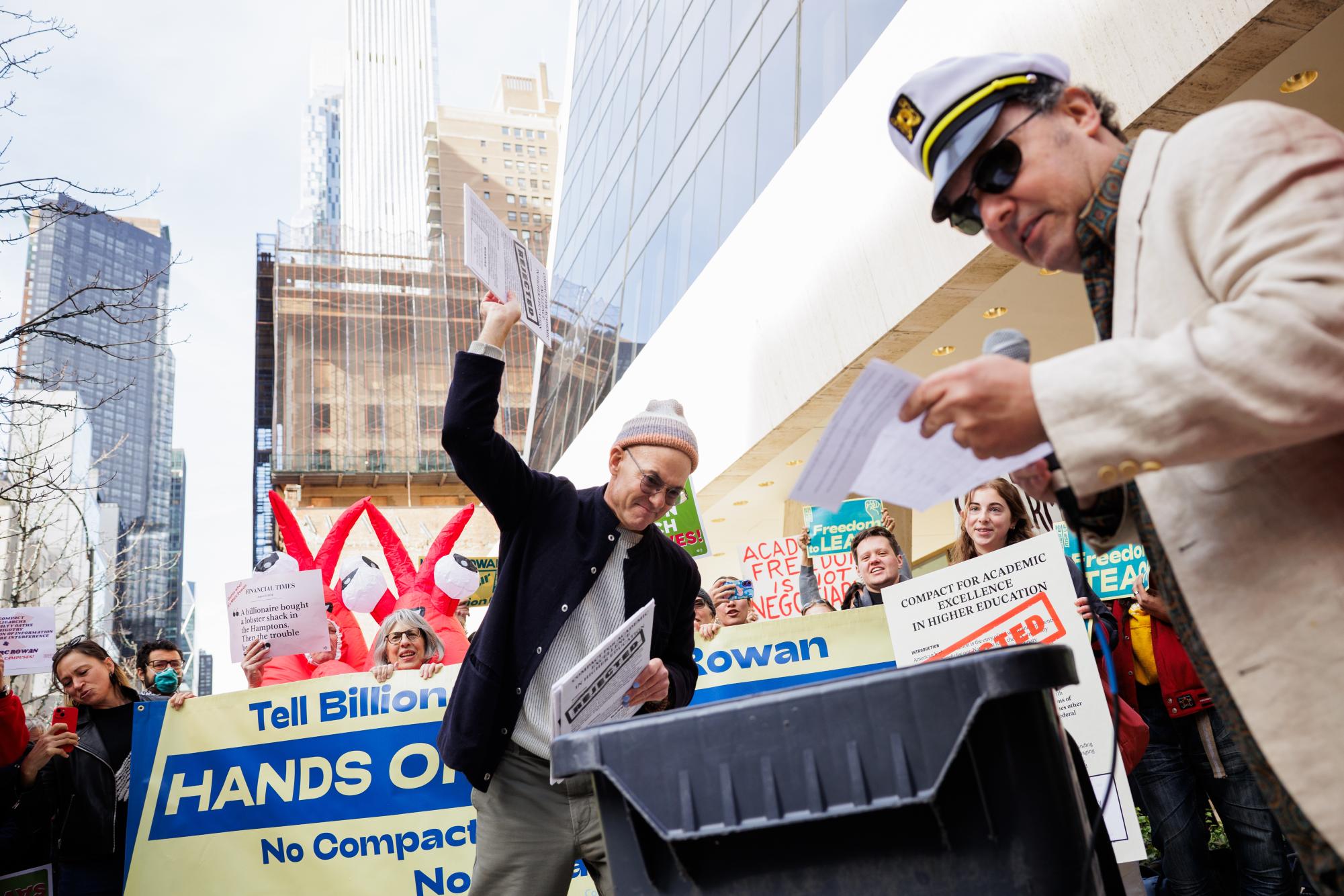
At 11 a.m., to start the protest, almost 200 attendees formed a picket line and performed chants while holding signs and moving in a circle as music played, according to Beaudoin.
Several people spoke, including Todd Wolfson, the president of the national AAUP organization. Beaudoin said they also did a demonstration where they announced the schools that were offered the compact and represented their rejection of the document by throwing a copy of the document in a large trash can.
Members of the Fordham Graduate Student Workers Union (FGSW) also attended the protest. Preston Carter, the business agent of FGSW, said that it was important to see both students and faculty fighting for the same cause.
“Seeing students and faculty organize side by side underscored that this is a shared struggle. It’s us versus them, the 99% for education against the 1% for profit maximization,” Carter said in an email.
Carter also explained why FGSW decided to attend, saying the compact has negative implications for both student workers and international students.
“As graduate workers, our working conditions are academic conditions. When billionaire donors try to dictate what can be taught, researched, or protested, they aren’t just shaping campus politics—they’re shaping our workplace,” Carter said. “The broader purpose was to insist that academic freedom and the safety of students–especially Palestinian, Black, brown, immigrant, and international students–cannot be ransomed away for donor approval or restored federal funding.”
Members of other AAUP chapters also attended the protest, including those from the University of Pennsylvania, Columbia University, the City University of New York, The New School and New York University, according to Beaudoin. Other organizations included New York State United Teachers, the Debt Collective and Higher Education Labor United.
“It’s really great to be with other schools and just to see that this is a citywide, high education endeavor, and that it doesn’t matter whether you’re at a private school, a private college or university, public one, a small one, a big one, that we all see this moment is very dangerous,” Beaudoin said. “We want to stand up for what we value about higher education, we want to stand up for our students and we want to keep this enterprise independent.”
Beaudoin said Fordham AAUP and the other participating organizations will continue to take action and hold protests against the government’s attempt to influence higher education institutions. He said the next large demonstration will be held on May 1 and will once again include demonstrations across the country.