



























































































































































































The Fordham University United Student Government (USG) is in the midst of lobbying the university administration for an amendment of the current contraceptive distribution policy to allow community members to distribute contraceptive materials on campus property. This has been a subject of discourse on campus for at least 60 years.
Fordham’s current policy on contraceptives allows for their possession on campus but prohibits their distribution on university property, at university events or with the use of university resources. The policy makes exceptions for medical conditions such as menstrual cycle irregularities and polycystic ovary syndrome, which can be treated with the use of hormonal contraceptives.
USG wants an amended policy that allows for the distribution of contraceptives on university property, while maintaining the provision prohibiting distribution at university events or with the use of university resources. Senator Henry Carstens, GSB ’29, said the policy is not intended to elicit university endorsement of contraception, but rather to give autonomy back to its students and allow students to freely distribute contraceptives.
“One of the big mischaracterizations of what we’re trying to do here is we’re not trying to seek funding,” Carstens said. “We’re not seeking even outright support for this, or allowing us to be at, like, big university-sponsored events. All we’re saying is, if I, right now, wanted to give you a condom, that’s not illegal [according] to the student handbook.”
In being a Jesuit institution, Fordham’s current policy is rooted in Catholic doctrine. The Vatican first released language on contraception in Pope Pius XI’s 1930 encyclical Casti Connubii, which stated that “any use whatsoever of matrimony exercised in such a way that the act is deliberately frustrated in its natural power to generate life is an offense against the law of God and of nature, and those who indulge in such are branded with the guilt of a grave sin.”
Executive Director of Campus Ministry Phillip Judge, S.J., explained that, as a Jesuit university, Fordham follows Catholic social tradition and teaching and promotes Catholic values. The university aims to uphold Catholic morality, which includes values like promoting free speech and the unionization of workers on campus, as well as opposing artificial contraception, according to Judge.
“A Catholic university tries to follow Catholic tradition in terms of the scholarship it encourages and provides,” Judge said. “If something is not allowed, then the university is a Catholic institution and shouldn’t allow it.”
The Catholic Church is also against any promotion of the use of contraceptives, which is reflected in Fordham’s policy. In upholding this doctrine, the University Health Center (UHC) does not provide any form of contraception except for any documented medical reasons, but they do provide testing for sexually transmitted infections (STIs). The student handbook states that the university’s primary method in addressing concerns about and preventing STIs and HIV/AIDS is educational.
“Fordham University endorses the understanding of human sexuality that is consonant with Catholic tradition. This approach finds its central principles in a view that is inherently linked to mutual fidelity in family living,” the handbook states. “Although this perspective informs our programs at Fordham, it is not inconsistent with this outlook to also ensure that comprehensive information on human sexuality be made available to the University community. Fordham recognizes that responsible sexual behavior involves both a grasp of ethical and moral principles and a fully informed view of human sexuality.”
Judge added that educating students on contraception does not violate Catholic doctrine.
“It [doesn’t] mean that just because something is immoral, that people shouldn’t know about it,” Judge said. “Even education on artificial contraception isn’t seen as promotion of that contraception, in the same way that talking about suicide is not necessarily promoting suicide.”
The Ram reached out to President Tania Tetlow and Associate Vice President for University Communications Jen Petra regarding the policy amendment process and the university administration’s position on USG’s proposal, but they declined to make a statement at this time. The Ram also reached out to UHC Director Maureen Keown who also declined to make a statement.
Records show that discourse and education efforts concerning contraception at the university have been ongoing since the 1960s. However, the student handbook archives don’t show a contraception policy until at least 2008. While Fordham does not have publicly accessible digital archives of the student handbook, The Ram was able to obtain physical copies of the 1987-88 Student and Residential Life Handbook, 1988-89 Student Handbook, 1989-90 Residential Life Handbook, 1990-91 Student Handbook and 2007-08 Student Handbook, and found that none of these editions included a policy on contraception. The Ram was unable to obtain handbook archives for any editions past 2007-08, so it is unclear when the university’s contraception policy had been implemented. However, Wayback Machine, an internet archive, shows that the policy was included in the 2015 handbook, meaning it was likely added between 2008 and 2015. Judge, who started his position at Fordham in the fall of 2024, said he was unaware of when the policy had been implemented.
History of Contraception Policy and Advocacy at Fordham
Past coverage by The Ram and The Fordham Observer shows that discourse regarding contraception at Fordham and student advocacy in support of contraception resources dates back to at least 1967.
In the May 5, 1967 issue of The Ram, an article titled “TMC Petitions University for Contraception Advice” detailed a petition created by a group of women at Thomas More College (TMC), Fordham’s women’s college at the time. The petition, which reportedly received at least 175 signatures, asked the university to provide the women with information on contraception and off-campus resources.
The New York Times published an article in its May 11, 1967 issue, which had revealed that Fordham’s administration had agreed to meet the students’ request. The article stated that the lectures would begin the following fall and would include information on “contraceptive devices,” with a goal of sex education. According to the article, a Fordham official said that “the program did not mean any departure from the Roman Catholic Church’s opposition to artificial birth-control devices.”
On Oct. 10, 1967, Fordham held their first event in the sex education series, according to an article in the Oct. 6, 1967, issue of The Ram.
Several other articles detail ongoing efforts by Fordham’s administration with providing students with education on contraceptives throughout the latter half of the 20th century. In October 1990, Fordham held an AIDS Awareness Week, according to an article in the Nov. 7, 1990, issue of The Observer, to inform students about who could contract AIDS and how it spreads. At the event, Fordham professor David Koch, who at the time taught a class titled AIDS and Psychology, spoke about abstinence and outercourse as two methods to avoid contracting AIDS. He also spoke about contraceptives as a form of protection for those who do choose to have intercourse.
Additionally, a Ram article titled “Fordham’s realistic new approach to sex on campus” from Nov. 29, 1990, spoke about a Freshman Symposium class that had a class period dedicated to contraception. The article stated that during the class, oral birth control and condoms were passed out for educational purposes.
According to the student handbook archives, The Ram found that prior to having their explicit contraceptive policy, the only policy in the student handbook related to contraception and STIs was the AIDS policy, which was found in the 1990-91 and 2007-08 editions of the student handbook.
“Fordham University as a Catholic University endorses the understanding of human sexuality that is consonant with Catholic tradition,” the AIDS policy, which was the same in both editions, stated. “Although this perspective informs our programs at Fordham, it is not inconsistent with this outlook to also ensure that comprehensive, current, and accurate information on human sexuality be made available to the University community.”
As according to Senator Domenick Fedele, FCRH ’29, Fordham’s Residential Life Handbook has also historically included a “Moral Growth and Responsibility” policy which mandated that students practice abstinence before marriage. This policy can be seen in the 1989-90 handbook pages obtained by The Ram. The policy still appears in the current student handbook, although the wording has changed and no longer mandates abstinence.
Although the various student handbook archives do show that Fordham’s contraception policy was created sometime between 2008 and 2015, past newspaper coverage shows that Fordham’s administration began taking actions in order to prevent the distribution of contraceptives on campus in 1989.
An article in the Sept. 7, 1989, issue of The Ram, which was titled “Magazine with Condom Banned on Campus,” said that a national college magazine, that was called Campus Connections had been banned from being circulated at Fordham because it contained an ad with a free condom attached to the page. According to the article, the administration banned the magazine’s distribution after an Aug. 24 New York Post article titled “Jesuit-run Fordham University will distribute a student magazine with a free condom inside” brought light to the intended distribution. The Ram article stated that the university’s administration had no prior knowledge that the magazine would include a condom, and it also said that the university declined to comment on the reason for its action.
According to an article in the Sept. 26, 1991, issue of The Ram titled “Administration nixes Deli’s attempt to sell condoms,” Fordham’s Student Deli, which used to inhabit what is now The Grotto, decided to sell condoms to students back in 1991. However, the then-Dean of Student Services Gregory Pappas asked them to remove the condoms from the shelves. The students were said to be in violation of university policy by selling condoms. Vice President of Student Affairs John Shea, S.J., told Pappas and the Deli moderator Michael Sullivan that selling condoms was against Catholic doctrine and could be seen as endorsing contraception. He also said that their actions could be interpreted as university policy because Deli managers were university employees.
After the Deli was prohibited from selling contraceptives, records show no other efforts by Fordham students to distribute contraceptives or by Fordham’s administration to prohibit the distribution of contraceptives until 2011.
However, during the hiatus, records show inconsistencies in reporting regarding services provided by the Health Center. The Catholic church’s Ethical and Religious Directives for Healthcare Services states that “procedures that induce sterility are permitted when their direct effect is the cure or alleviation of a present and serious pathology, and a simpler treatment is not available.” This doctrine is upheld by Fordham’s contraceptive policy, which states that the University Health Center can provide hormonal contraception for medical purposes.
But there are multiple documented instances of the Health Center not following this policy, including in 2004, when The Observer reported that Claudia Weinstock, FCLC ’06, requested birth control from UHC for medical reasons and was denied, and 2012, when The Observer reported that a law student was denied contraception for her ovarian cyst. Records also show that throughout the years students have questioned whether Fordham’s insurance plan requires the Health Center to provide contraceptives.
But still, Fordham has continued to uphold this Catholic doctrine, and students have continued to take action to oppose the contraception policy. In 2011, Fordham’s Law Students for Reproductive Justice club created Prescribe Fordham, a bi-annual birth control drive.
In 2014, a student group called Students for Sex and Gender Equality and Safety (S.A.G.E.S) began to distribute contraceptives on campus. S.A.G.E.S. efforts continued until at least 2019, but no coverage can be found regarding the group past that date.
Other efforts to promote contraceptives at Fordham include a 2022 USG proposal to create a contraceptive clinic and a 2025 distribution initiative by the Fordham chapter of Young Democratic Socialists of America, which is an unofficial club at Fordham.
Now, contraceptive promotion efforts are being continued by USG with their proposal lobbying for an amendment to the university’s contraceptive policy.
The USG Contraception Proposal
USG’s Contraceptive Policy Commission, which includes Vice President of Health and Security Aidan Costella, FCRH ’27, Carstens, Senator Audrey Shooner, FCRH ’28, Fedele and Senator Anna Wiss, FCRH ’26, has been working on this proposal since the start of the fall semester.
In creating the proposal, Fedele and Shooner conducted extensive research on the history of contraceptive policies at Fordham and other Jesuit universities.
“It’s an issue of health and wellness for all students at Fordham,” Fedele said. “We both recognize how important this proposal is and how many members of the university community have a vested interest in this, and we really want to make sure that we have all the facts straight that we meet with all the stakeholders and we put together the best proposal possible.”
The initiative is motivated by the desire to protect students’ health, according to Executive President Lucas Hjertberg, FCRH ’26. As stated by the Center for Disease Control (CDC), youths (ages 15-24 years old) have been disproportionately affected by STIs and sexually transmitted diseases (STDs), and they make up 25% of the sexually active population while accounting for 50% of new STI cases in the U.S. each year. Hjertberg said it is Fordham’s job to address this student health issue.
“So much of this screams to me, you know, kind of cura personalis, and the care of the whole person,” Hjertberg said. “I don’t understand why the care for the whole person would start from the top of your head and then end at your beltline.”
Judge said he knows that students at Fordham use contraceptives and that he will not criminalize those students for doing so. However, he also said the university stands by Catholic doctrine and will not be involved in providing contraception.
“I know that students make their own moral decisions, as every adult makes their own moral decisions. I’m not in favor of criminalizing moral decision-making. So I think students who choose to make use of artificial contraception have chosen to do that. And there’s nothing I can or would do about that,” Judge said. “To my mind, that’s not the issue. Those contraceptive methods are available off campus or available by mail. They’re available readily. The question is whether or not the university should be involved in allowing the distribution of those on campus.”
Carstens said he acknowledges that Catholic doctrine is against the promotion of contraception, but at the same time emphasized that USG’s intention is not to elicit university support for contraceptives, since that could create issues for the university with donors and alumni. He said he believes USG’s policy allows students to have the freedom to distribute birth control while also not creating university endorsement of contraceptives.
“I think this is a very pragmatic way to approach it,” Carstens said. “We’re going to have the best of both worlds. You know, you give the autonomy back to the students in this sense, and you don’t go and, I guess, maybe make it more an issue with donors or something.”
The Ram looked into the contraceptive policies at the 28 Jesuit universities in the U.S. and found that Fordham’s policy differs from the majority of others, most of which do not include a written policy completely banning the distribution of contraceptives on campus. Universities that have a written distribution ban generally prohibit the university itself, including the University Health Center, from dispensing contraception, but don’t include an outright ban of distribution on campus property. Universities with this type of policy include Gonzaga University and Saint Louis University. Some institutions, including Fairfield University, also prohibit university-sanctioned groups from distributing. However, The Ram did not find any other written university policies with a complete ban on distributing contraceptives on campus property.
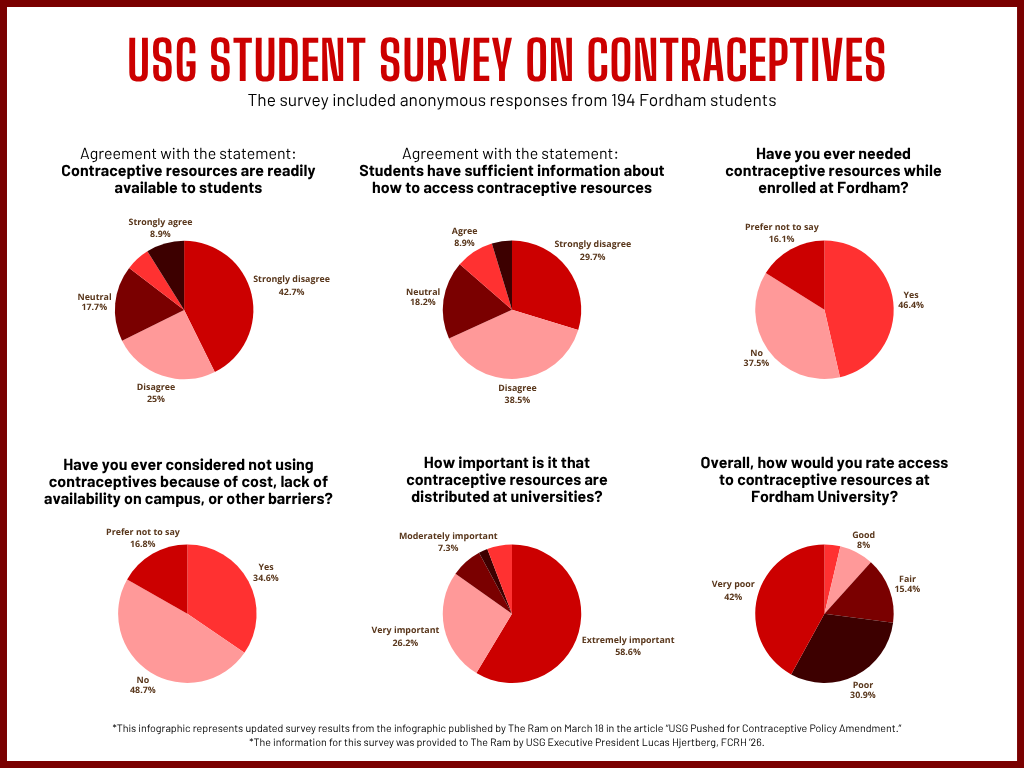
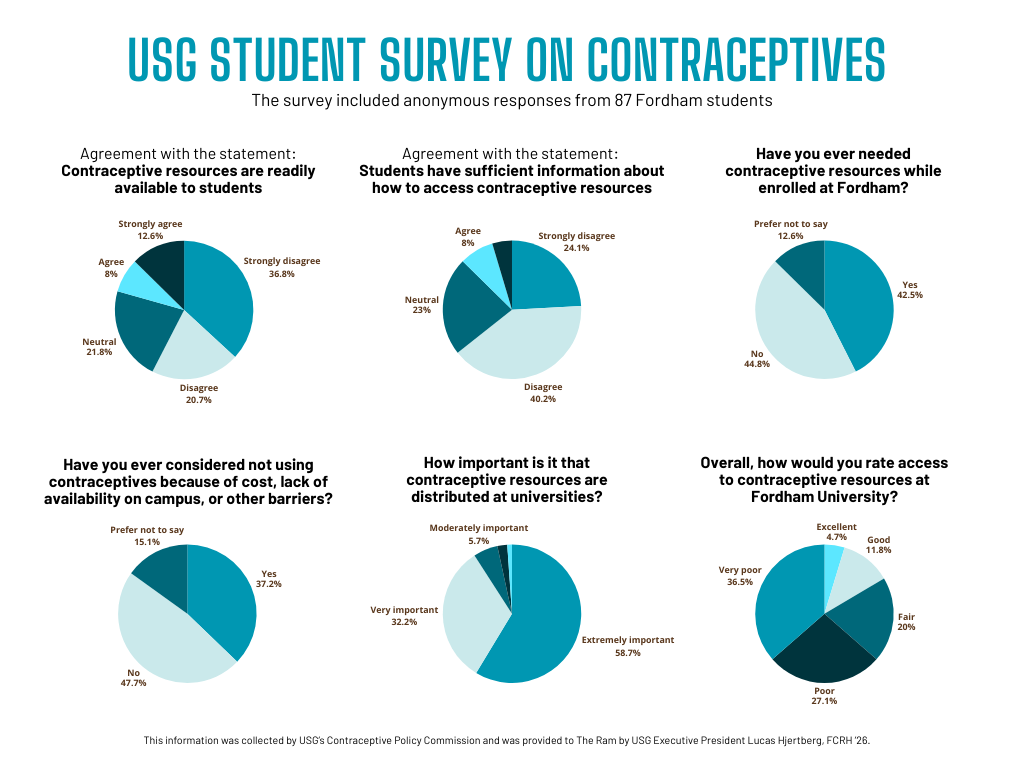
USG’s Contraceptive Policy Commission recently conducted an anonymous survey to gauge student opinion on contraceptives and contraceptive access at Fordham. The results, which included 87 respondents and indicated an overwhelming amount of support for USG’s proposal, were shared with The Ram by Hjertberg.
Regarding contraception at Fordham, 58% of respondents disagreed with the statement, “contraceptive resources are readily available to students,” while 21% agreed. Additionally, 64% disagreed, and 13% agreed with the statement “students have sufficient information about how to access contraceptive resources.” Regarding access to contraception at Fordham, 64% said access is poor, 20% said it is fair, 12% said it is good and 5% said it is excellent.
The survey also had asked respondents how important it is that contraceptives are distributed at universities. Over 90% of respondents said it is either very or extremely important, while 8% said it is moderately or slightly important and 1% said it is not important at all.
Looking Forward
Before the proposal can be shared with the administration, it must be voted on by USG, after which it will be brought to Rose Hill Dean of Students Kevin Williams if it passes. From there, the administration will have discretion over changing the policy. Because the amendment requires a significant policy change, Hjertberg said he expects the proposal may go all the way to Fordham’s Board of Trustees before it could be implemented.
In the meantime, the USG’s Contraceptive Policy Commission is continuing to seek student support for the proposal. On Friday, March 20, at 6 p.m. in the Great Hall in the McShane Student Center, they will table at USG’s State of the Student Address to talk with students and gather support.
“So much of this is getting [and] gathering student support behind this specific change,” Hjertberg said. “Because without that, there’s no guarantee. And there still is no guarantee. But it’s the student support behind it that allows this to become an issue on the docket.”