






































































































































Figure skating has exploded in popularity over the last couple of months, especially in the wake of Alysa Liu’s gold medal at the Olympics in February. She did the unthinkable: dominating over veteran Kaori Sakamoto, despite Liu herself only coming out of retirement less than two years prior. Ilia Malinin, despite failing to medal, has also started valuable conversations about athlete mental health, rule reform and the future of the sport as he continues to push the boundaries of his technical capabilities.
Pre-Olympic fans of the sport certainly look forward to the World Championships: it is the culmination of the competitive season, after all. But the resurgence of the sport has brought hundreds of thousands of new fans, so for the last week of March, all eyes were on Prague. Three of the reigning Olympic champions withdrew, which was bound to produce some interesting podium results at Worlds.
The World Championships are also exciting because there are more opportunities for skaters to win medals. Typically, skaters are awarded medals based on their total score from the two required programs: one short program (SP) and one long program/free skate (FS). At Worlds (and other major competitions, but not the Olympics), skaters win “small” medals for placing in the top three in either the short or long program, independent of their final result.
Men’s singles is personally my favorite discipline of skating despite its reputation as the most unpredictable discipline in the sport. The unexpected 2026 Olympic champion, Mikhail Shaidorov of Kazakhstan, withdrew from the World Championships shortly after winning at the Olympics — a common course of action for champions, who prefer to utilize their time post-win securing sponsorships and federal support rather than training for Worlds.
Unsurprisingly, Ilia Malinin left Prague with his third consecutive World Championship win. His programs are technically unbeatable — his ability to land all six kinds of quadruple jumps, one-footed backflips and his signature “Raspberry Twist” give him an edge over the entire field. As Malinin wrapped up his season with his third Worlds title, most people wondered: Does his third world title make up for losing at the Olympics or will it only cement his drive to continue fighting for Olympic gold in 2030?
The podium was rounded out by Yuma Kagiyama and Shun Sato, both from Japan, and the silver and bronze medalists of the Olympics, respectively. Kagiyama rallied from a devastating mistake in the short program to skate one of the cleanest long programs of his career, adding another silver medal to his collection of 10 senior international silver medals. Sato showcased his commendable consistency, completing a career Bronze Slam to finish his season.
Some notable non-podium programs included Aleksandr Selevko SP, Adam Siao Him Fa SP and Stephen Gogolev SP and FS.
In women’s singles, it was time to say goodbye to a legend. Kaori Sakamoto announced last fall that she would be retiring at the end of this competitive season. Sakamoto, disappointed with her silver medal at the Milano Cortina Olympics, vowed to come to the World Championships looking for a satisfying end to her competitive career. Her short program “Time to Say Goodbye” and free skate “Hymne à l’amour” (“Hymn to Love”) ensured there wasn’t a single dry eye in the stadium, or in fans’ eyes at home. And with Olympic Champion Alysa Liu absent, Sakamoto faced no major obstacles in her path towards victory.
Mone Chiba of Japan, who narrowly missed the Olympic podium, delivered a masterclass in skating skills and picked up the silver medal. Nina Pinzarrone of Belgium, a surprise bronze medalist, combined two flawless programs to win her first World Championship medal, showcasing that even as we lose the legendary Sakamoto, the future of women’s figure skating burns bright.
Some notable non-podium programs were Amber Glenn SP and Jia Shin FS.
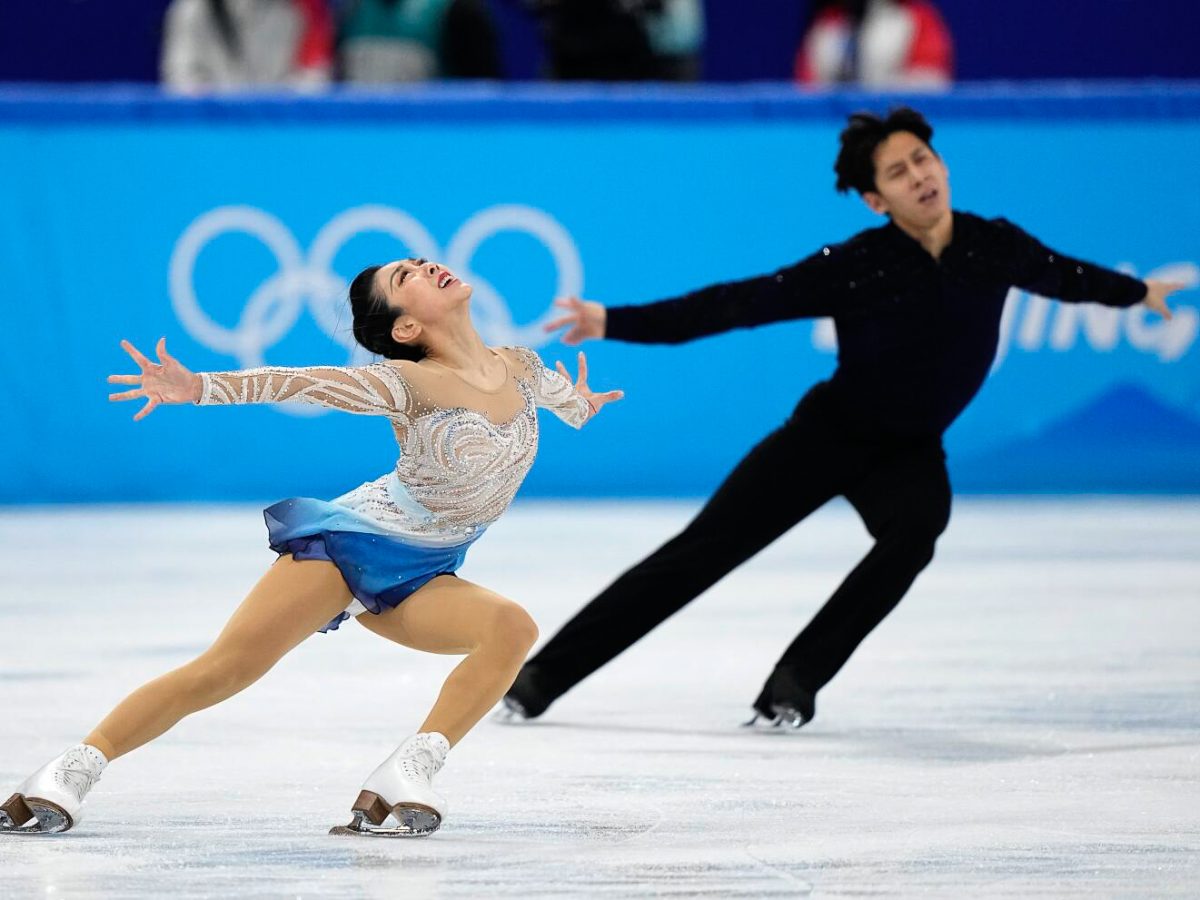
If you’ve ever seen videos of figure skaters doing crazy stunts like throwing a woman 10 feet in the air as she spins three times, launching her across the ice or completing side-by-side jumps, you were probably watching the nail-biting discipline of pairs skating.
With the absence of Japanese Olympic champions Riku Miura and Ryuichi Kihara, the remaining Olympic medalists were battling for a spot at the top of the podium. Most viewers thought the gold and silver medal spots were pretty set in stone — it was a toss-up between Germany’s Minerva Fabienne Hase and Nikita Volodin and Georgia’s Anastasiia Metelkina and Luka Berulava — and they were correct in their guess. The bronze spot, therefore, was up for grabs and ultimately clinched by Canadians Lia Pereira and Trent Michaud, who were seeking redemption after their unsatisfying performance at the Olympics.
If you have a moment, go check out a pairs program. You’re guaranteed to have your mind blown!
The duos of Yuna Nagaoka and Sumitada Moriguchi FS as well as Maria Pavlova and Alexei Sviatchenko SP offered memorable non-podium programs.
Finally, ice dance is probably the most controversial, political and misunderstood of the four disciplines. Prague was a refreshing change from that characterization, with one major exception.
Reigning Olympic champions Laurence Fournier Beaudry and Guillaume Cizeron of France were not a team until early 2025. Cizeron is a former Olympic champion ice dancer whose old partner quit the sport due to alleged abuse. Fournier Beaudry was partnerless before Cizeron because her former partner (and current significant other) was suspended for allegations of sexual assault. The team took home a contentious gold medal in Milan over the established American team of Madison Chock and Evan Bates, and won gold again in Prague.
Most fans chose to ignore their performances, scoring and medals in light of all the controversy that surrounds the team. Instead, they chose to focus on the numerous positive performances of the night: Canadians Piper Gilles and Paul Poirier, who took home silver in what is likely to be their final competition, and Americans Emilia Zingas and Vadym Kolesnik who broke onto the scene last year, becoming one of the few ice dance teams in history to medal at their debut World Championships when they won bronze in Prague.

