



























































































































































While the Winter Olympics offer a sprawling stage for dozens of disciplines, none capture the world’s collective breath quite like the high-stakes dramatics of figure skating. The Milano Cortina Games kept fans deeply invested through a series of dramatic turns across every individual discipline.
The individual ice dance competition quickly preceded the conclusion of the team event. Things kicked off with the rhythm dance, which is a shorter, spunkier routine performed by the ice dancers. After this first day of competition, France’s Laurence Fournier Beaudry and Guillaume Cizeron were in the lead, less than one point ahead of Madison Chock and Evan Bates of the USA. Piper Gilles and Paul Poirier of Canada rounded off the top three. After the free skate, these rankings stayed the same with Fournier Beaudry and Cizeron winning the gold medal by a margin of only 1.43 points over Chock and Bates.
These results were controversial to say the least. France’s Fournier Beaudry and Cizeron have been competing together for less than a year and both appeared at the previous Olympics with different partners, but a series of suspicious circumstances involving sexual assault and abuse allegations brought them together. Alternatively, Chock and Bates have been skating together since 2011 and solidified their bond when they got married in 2024. They have been dominant at the International Skating Union (ISU) Grand Prix circuit and at the ISU World Championships. These results left many dedicated followers of the sport in shock and doubting the fairness of the judging.
The events of the men’s individual competition followed ice dance where fans were eagerly awaiting the individual Olympic debut of Ilia Malinin. He dominated the short program, finishing with a five point lead over Japan’s Yuma Kagiyama, with France’s Adam Siao Him Fa rounding out the top three. Going into the free skate, audiences were confident that Malinin would win the gold and become the first person to land the quad axel on Olympic ice. After all, Malinin is the only figure skater to have successfully landed the quad axel in competition, earning himself the title of “Quad God.”
The long program was turbulent to say the least. Throughout the competition, many of the men were struggling to land their routine jumps. Prior to Malinin’s performance, Kazakhstan’s Mikhail Shaidorov was sitting at the top of the leaderboard, moving up from fifth place after the short program. Malinin took the ice with what appeared to be confidence and ease, but as he attempted the quad axel, he seemed to falter mid-air and did two fewer rotations then planned. He then proceeded to fall twice during the remainder of the program. Defeat radiated from him the moment the music stopped. Malinin had fallen from first to eighth place, losing any shot at a medal. Shaidorov won the competition, an unlikely but nevertheless exciting result from the 21 year old. Japan’s Kagiyama and Shun Sato finished second and third, respectively.
In the wake of Malinin’s defeat, the world came together to support him. Athletes from all over the globe and across a multitude of sports recognized and acknowledged that the pressure these top performers face is no joke. Simone Biles, Nathen Chen, Tom Brady and many others reassured him that this performance does not define his career. He shared in interviews with the media that he has felt tremendous support throughout this hard time.
The pairs event was the next to take place. Japan’s Riku Miura and Ryuichi Kihara were favorites heading into the event as reigning World and Grand Prix Final Champions. Alas, the pair found themselves in fifth place after the short program due to costly mistakes in a lift. Germany’s Minerva Fabienne Hase and Nikita Volodin claimed the top spot. Despite the struggles in the short program, Miura and Kihara had a technically perfect free skate to clinch the gold medal. They finished ten points ahead of the second place pair from Georgia, Anastasiia Metelkina and Luka Berulava. The German pair ended up with the bronze medal.
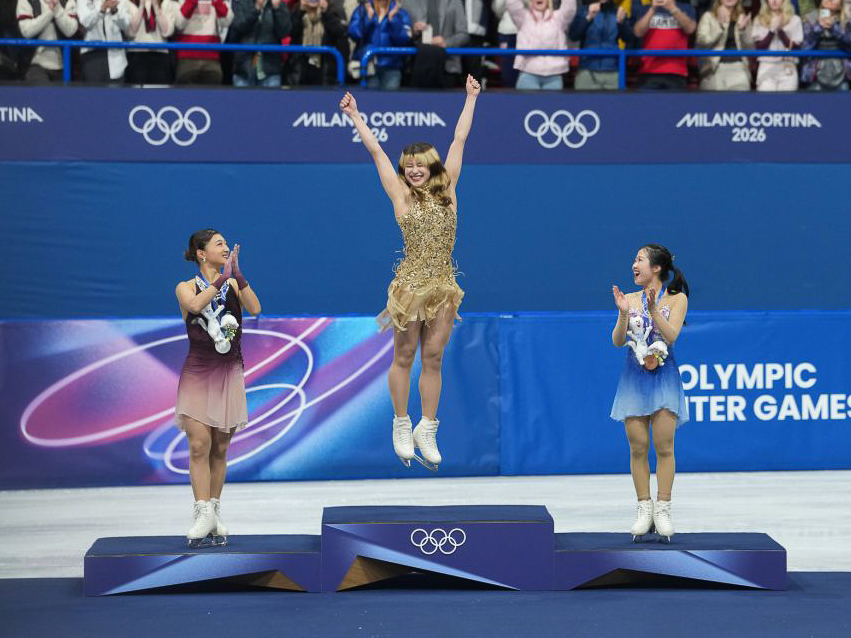
The last individual event was the women’s single. Japan’s veteran Kaori Sakamoto and 17-year-old Ami Nakai were some of the favorites, as well as Alysa Liu of the USA. Ami Nakai had a dynamic spirited short program featuring a triple axel, putting her in the lead in her Olympic debut, followed by Sakamoto and Liu. American superstar Amber Glenn found herself in 13th after a popped triple loop, giving her no points. Going into the free skate Glenn was determined to prove herself on Olympic ice. She moved all the way back up to fifth place and had the third-highest free skate score in the competition. With a spirited program, Liu scored a career-best result in the free skate to win the gold medal. Sakamoto came in second in her final Olympics and Ami Nakai got the bronze medal.
Liu’s story of figure skating success is unique. She was a young prodigy and was turning heads in the figure skating world. She competed at the Beijing Olympics in 2022 at just 16 years old, placing sixth. Following the games she announced her abrupt retirement from the sport. Then in 2024 she decided to come back to figure skating on her own terms. She insisted on taking part in choreographing and designing her routines, and she was especially adamant that no one was going to control her or tell her what to eat. Her gold medal proves that you can win on your own terms.
I don’t think that any figure skating aficionado could have come close to predicting these results; nevertheless, the people were entertained.