














































































The tunnel outfit walk has been showing off players’ personal styles and depicting messages through their outfits.
On Sept. 14, Haley Hopkins alongside her teammates from the Kansas City Current of the National Women’s Soccer League (NWSL) wore shirts that read “pay them what you owe them.”
Hopkins, the president of the NWSL’s Players Association, wore this to show solidarity with the Women’s National Basketball Association (WNBA) as the leagues continue to fight for a new collective bargaining agreement (CBA).
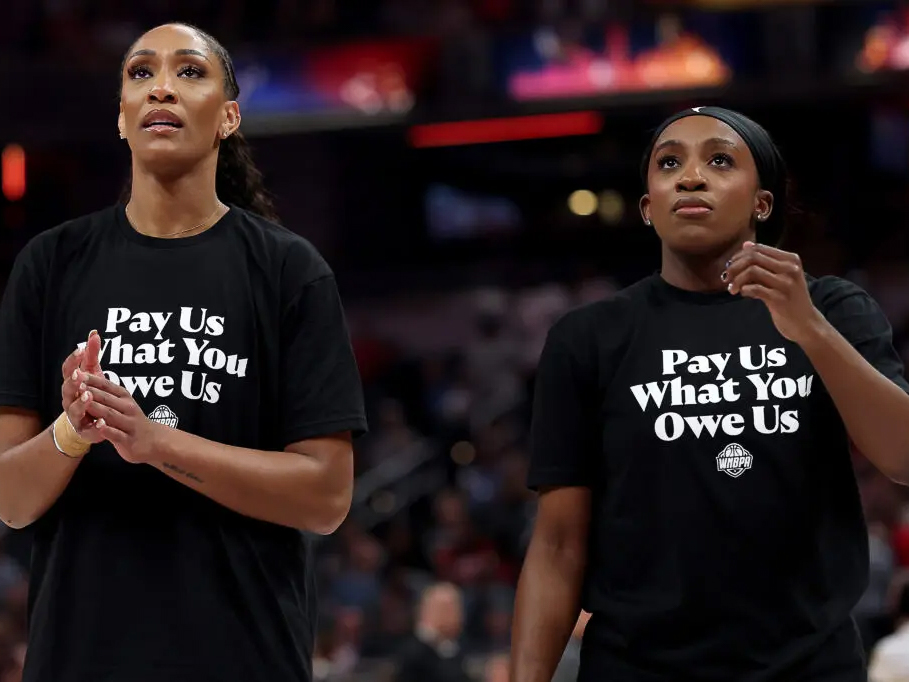
The WNBA All-Star weekend was the first time the players warmed up wearing “pay us what you owe us” attire. This came after a mid-July meeting with over 40 players who met with league Commissioner Cathy Engelbert.
“But I think, to be frank, it was a wasted opportunity. We could have really kind of gotten into a deeper dive of everything,” said Breanna Stewart of the New York Liberty after the first meeting. “Based on their most recent proposal, we just aren’t able to get to a place where we’re actually even talking about the same thing.”
Erin D. Drake, the senior advisor & legal counsel for the Women’s Basketball National Player Association (WBNPA), spoke at Sportico’s RISE event on Sept. 17 about what it was like to prepare the players to have their voices heard through the t-shirts.
“It was an opportunity for players to speak in their own voice about how they were feeling. As a staff for them, all we do is prepare for when their iron wants to strike,” Drake explained at the Sept. 17 event.
The WNBA is not new to protesting by using t-shirts as their mode of delivering their message. In 2016, after the killing of Philando Castile and Alton Sterling, Minnesota Lynx players wore t-shirts that read “Black Lives Matter” to protest police brutality.
One of the main divides of the CBA with the league and the players involves revenue sharing. As the league grows bigger, the players want a split of the league revenue when business is booming.
The league is currently only splitting 9.3% of the revenue with the players compared to the other four major league sports, which are exclusively male, that receive an almost exact 50/50 split.
Right now under the current CBA, the WNBA is not getting any shared revenue for jerseys, merchandise and ticket sales. It also adds more questions surrounding the revenue split due to the fact that the WNBA signed a brand new television rights deal that will bring in over $200 million per year.
The players are not going to see any of that money under the CBA. The other five teams have all paid $250 million to buy the right to have an expansion team in the coming years.
In the last few seasons, the WNBA has experienced record highs in not only viewership but also ticket sales. These things combined have led to a record evaluation for the league.
The franchise value is up by almost 180% with a collective value of over $36 billion. Even with these groundbreaking increases, Engelbert has been reluctant to provide for the revenue split that the players have been looking for.
“We’ve been building a new economic model, quite frankly, leading women’s sports to build that model with our new media rights deals and with all the corporate partnerships,” said Engelbert during the WNBA draft. “So yes, we want to have a fair deal for all, but it has to be within the confines of a sustainable economic model.”
What is happening today will only lead to one thing: a lockout when the players and the league won’t see eye to eye. If they continue to be dissatisfied, the players association can come together and put in a full work stoppage that will delay or cancel the 30th WNBA season.
And if this happens, the direct effects would be felt immediately. This would end all of the foot traffic that the WNBA brings to the cities that it plays in. It would delay the first season of the Portland Fire and the Toronto Tempo as expansion franchises.
Lockouts can be harmful for leagues, and this can set teams back for years. Right now, this would be poor timing for the WNBA who now have momentum in front of them, working in the teams’ favor. There will never be a concern if the CBA decides to pay the players a fair share of the revenue the players believe they are owed.
It’s a lot more than just a t-shirt to the players; it’s about getting the respect and the share of the revenue they believe they have earned. At the end of the day, the players are the reason people tune into the games every night, so without the players, there is no WNBA.

