

































































































































































Fans woke up bright and early Sunday morning to watch the highly anticipated 2026 Olympic Men’s Hockey gold medal game in Milan, featuring a very heated rivalry between Team USA and Team Canada.
Canada, coming off a major Four Nations victory against the USA and with a record of 12-5-3 when facing the United States in Olympic hockey, was the firm favorite to take home the gold. However, Jack Hughes, Connor Hellebuyck and their teammates had other plans. In order to understand the magnitude of this upset, you have to analyze each team’s performance throughout the 2026 Olympic Games.
Canada swept the preliminary round, with goaltender Jordan Binnington getting a shutout in their first game against Czechia. Logan Thompson took over in the crease against Switzerland in a solid 5-1 win for their second game.
In their third game, the Canadian offense carried the team to a 10-2 victory against France. Coming out of the first round having won each of their three games definitively, Canada was looking like the team to beat.
Team USA had a slightly different experience early. They took the ice right after Canada for their first game, with the final score of 5-1 being only a one goal difference from the face-off right before theirs. Despite tackling Latvia and emerging victorious, the second game of the tournament began rocky for the Americans. Going into the second period, the U.S. was down by one. However, thanks to Brady Tkachuk’s game-tying goal, they began the climb, winning 6-3 against Denmark.
The next day, Team USA was back on the ice to face Germany. This game resulted in the same outcome as their first, with the only allowed goal flying past Hellebuyck with just under 10 minutes left in the third. While not appearing as strong as Canada, American fans were feeling good going into the knockout stage.
By winning all three of their respective preliminary round games, Canada and the U.S. were solidly in the quarterfinals, giving both teams two days off while the rest went through the knockout stage. However, Feb. 18 came fast, and both teams were back on the ice to continue their fight for gold.
Canada went first, facing off against Czechia at 10:40 a.m. This game was nearly tragic. Canada went into the second period down one goal; to make matters worse, just over five minutes in, captain Sidney Crosby left the game with a lower body injury. Canada tied it back up to go into the third following two periods of heavier competition than they likely expected after shutting out Czechia in the preliminary round.
With just under 10 minutes left, Ondřej Palát scored and Canada was looking at the possibility of not only missing out on gold, but not going home with any hardware at all. However, Nick Suzuki scored and the game went into overtime. Mitch Marner delivered the game winner 1:22 into extra time and brought Canada back into medal contention.
Team USA hit the ice at 3:10 p.m. and had a very similar experience to Canada. Following a scoreless first period, Dylan Larkin scored the game’s first goal in the second. Sweden’s Mika Zibanejad tied it up in the third, and the two teams went to extra-time as well. Three minutes into a nail-biting overtime, Quinn Hughes made a beautiful wrist shot that allowed Team USA’s campaign for gold to continue.
Both teams returned Friday following the women’s hockey final, where the U.S. beat Canada 2-1 in overtime. Canada played Finland in the morning, where they narrowly avoided disaster yet again.
On a power play, Mikko Rantanen opened the scoring with an assist from Sebastian Aho in the first. Three minutes into the second, Erik Haula extended Finland’s lead with a shorthanded shot that slid past Binnington. It was not looking good for Canada.
Just under halfway through, Sam Reinhart scored, but the team was still down by one. In the third, Shea Theodore tied the game.
Every Canadian fan was on the edge of their seats. With one minute to go, things were looking set for overtime. However, with 37 seconds left in regulation time, Nathan McKinnon knocked in a power play goal to send Canada to the gold medal game.
Team USA returned in the afternoon for a much less dramatic performance against Slovakia. The U.S. dominated the first two periods with five goals, two of them made by New Jersey Devils star Jack Hughes. In the third, Slovakia put up some fight with two goals, one by Juraj Slafkovský and the other by Pavol Regenda; the U.S. shut them down with a goal from Brady Tkachuk to make the final score 6-2.
Following these quarterfinal face-offs, Canada and the U.S. were set to repeat history in the gold medal game. Despite Canada being the first seed and the overall favorite with its incredibly stacked roster, their performance in the quarterfinals, when compared to the U.S.’s outcome, made fans unsure of what they would see come Sunday.
The puck dropped at 8:10 a.m. Matt Boldy gave Team USA the early lead six minutes in; however, Cale Makar tied the score late in the second. The teams battled through a scoreless third, with multiple penalties and even a brief segment of 4-on-4 hockey. The U.S. killed their final penalty, and the gold medal was still up for grabs in overtime.
Per Olympic overtime rules, it was a three-on-three contest to determine the final 2026 Olympic rankings. Following a series of line changes, Larkin, Zach Werenski and Jack Hughes found themselves fighting for the puck.
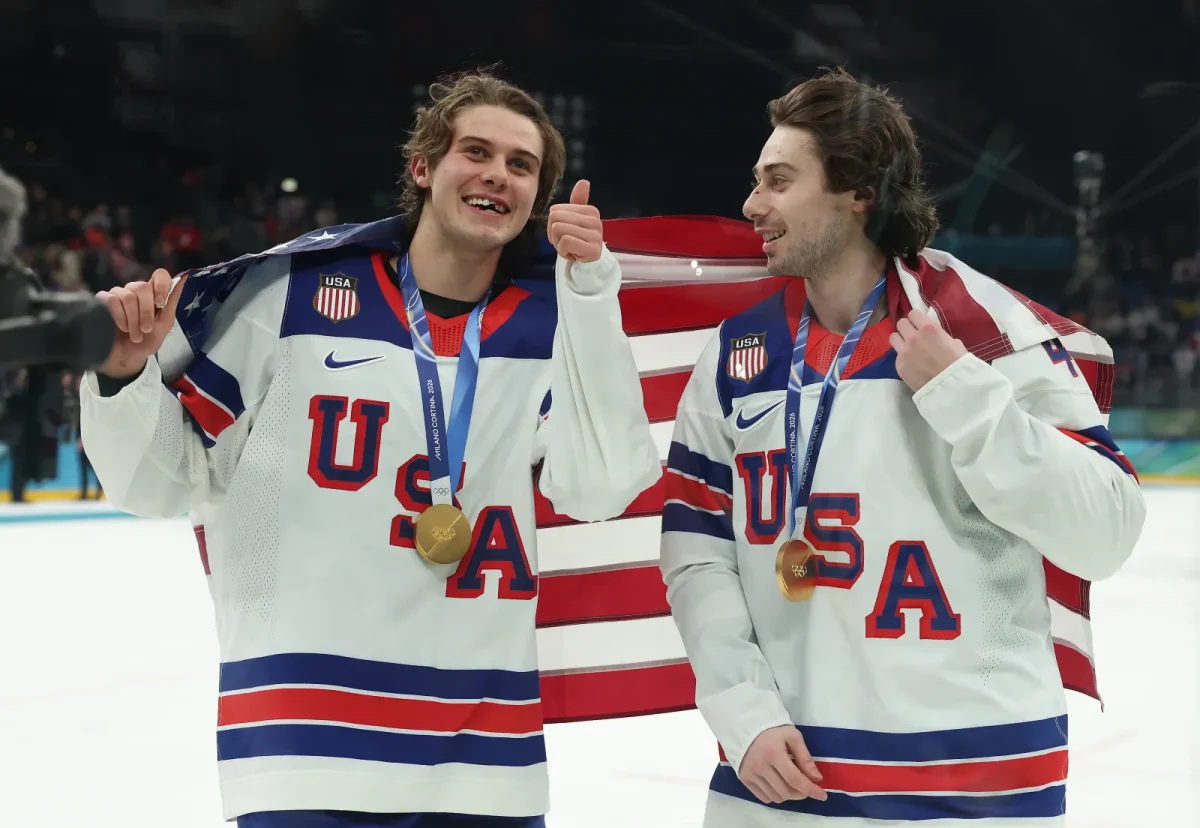
After being on the ice for under a minute, Jack Hughes, on a pass from Werenski, shot the puck. Everyone watched as it flew past Binnington to nestle itself into the back of the net. The crowd, and American fans around the world, erupted. Team USA flooded the ice and swarmed their very own #86.
This shot marked the third Olympic Men’s Hockey gold for the U.S., and the first one since 1980’s “Miracle On Ice” team. With his own golden goal, Jack Hughes made history; but he wasn’t alone. Hellebuyck saw 42 shots during the game for gold, 14 more than Binnington. He only let one through. For Most Valuable Player, Hellebuyck had a strong case.
The emotion of the finale didn’t just stop at the medal; brothers Brady and Matthew Tkachuk, alongside their teammates, sought to honor the late Johnny Gaudreau.
Before his tragic passing in 2024 due to a car accident, Gaudreau was thought to be a shoo-in for the 2026 Olympic hockey team. Throughout the tournament, the team kept his jersey hung up in the locker room in tribute.
Not only did the Tkachuk brothers bring Gaudreau’s jersey out onto the ice, but Larkin and Werenski carried out his two kids to participate in a team photo following their gold medal ceremony.
While Canada might have had the stronger roster on paper, Team USA proved something with this victory. Family and a team of equals can make a win truly golden.