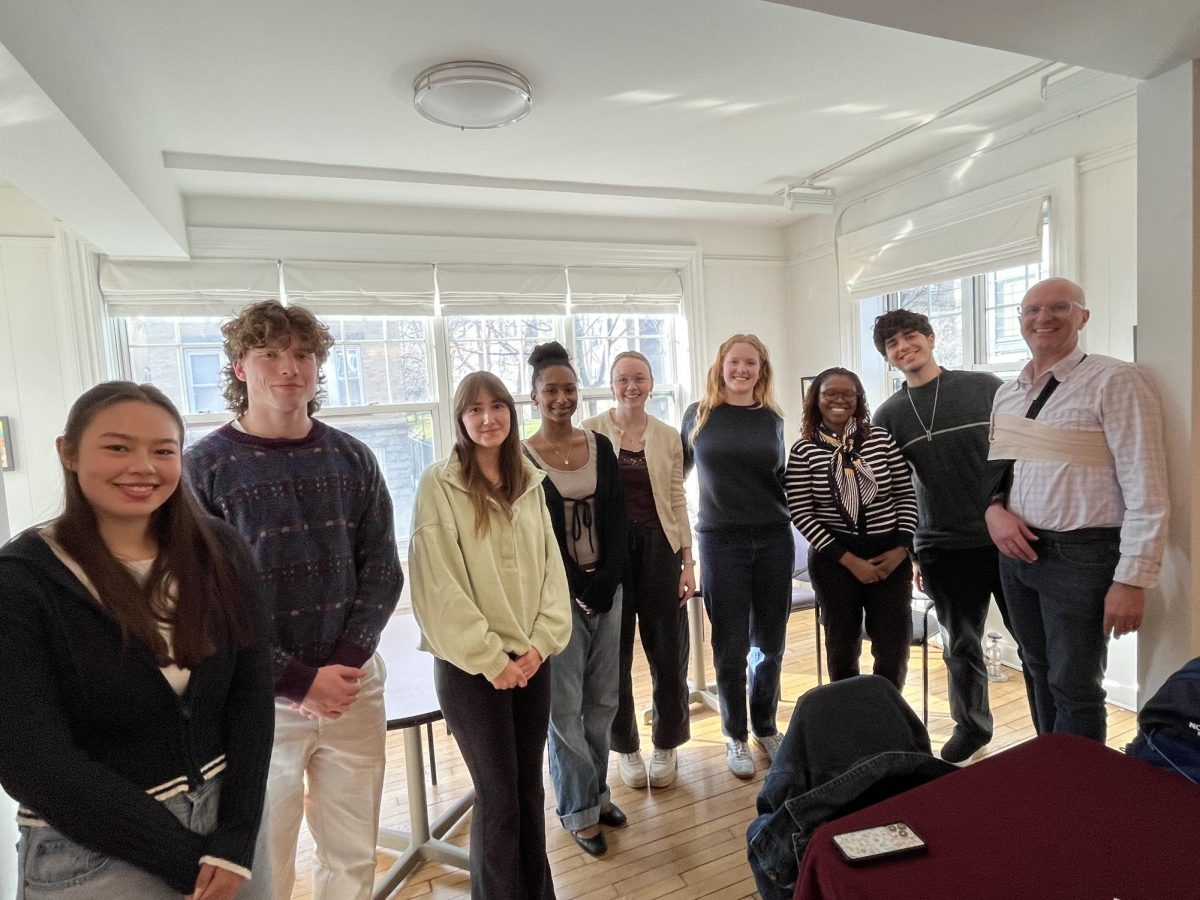


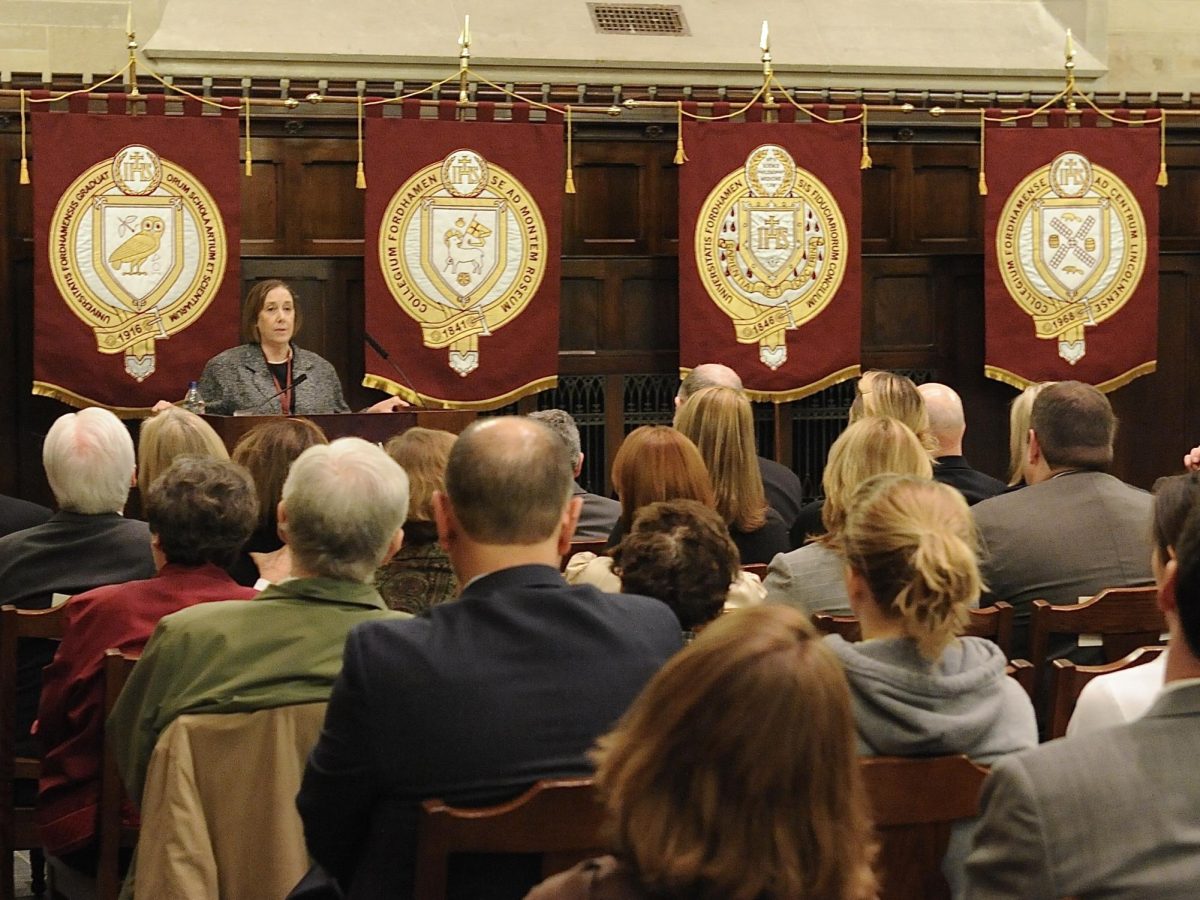










































































































































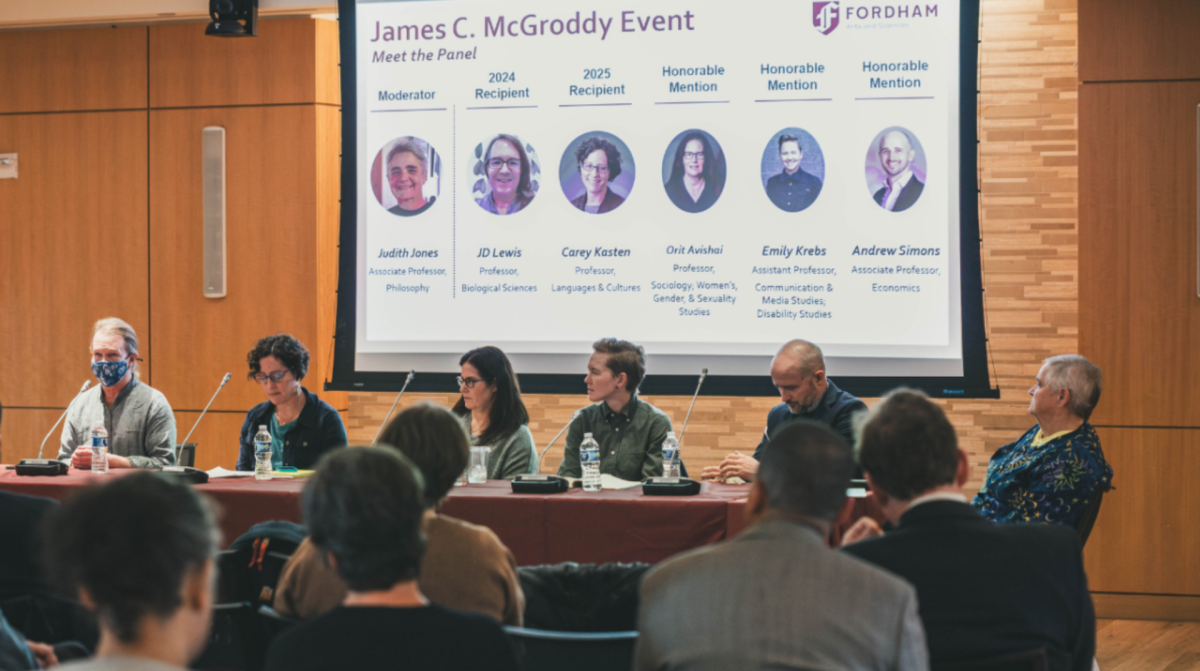
Fordham University’s department of Arts & Sciences recognized five faculty members at the James C. McGroddy Award Ceremony for Innovation in Education on Nov. 4. The event featured a panel discussion with award winners, moderated by Judith Jones, associate professor of philosophy. Panelists reflected on teaching, interdisciplinary collaboration and celebrated how Fordham’s faculty shapes the academic and personal growth of students. The ceremony is named for James. C. McGroddy, Ph.D., a distinguished Fordham donor in climate sciences.
This year’s winners were Carey Kasten, Ph.D., and Leo Guardado, Ph.D., who won for their work on Fordham’s Initiative on Migrants, Migration and Human Dignity.
Kasten is a professor of Spanish whose work features a partnership with several organizations, including the Little Sisters of the Assumption, Jesuit Refugee Services and Ignatian Solidarity Network. The foundation develops meaningful relationships with its partner organizations and advocates for migration justice.
Guardado, associate professor of theology, leads the program with Kasten. Since the initiative’s inception, Guardado and Kasten have accompanied students on Global Outreach (¡GO!) trips to the Mexico-United States border, where they have spent time reflecting on the migrant experience. They also invite alumni to help lead these treks.
Three other professors received honorable mentions at the ceremony.
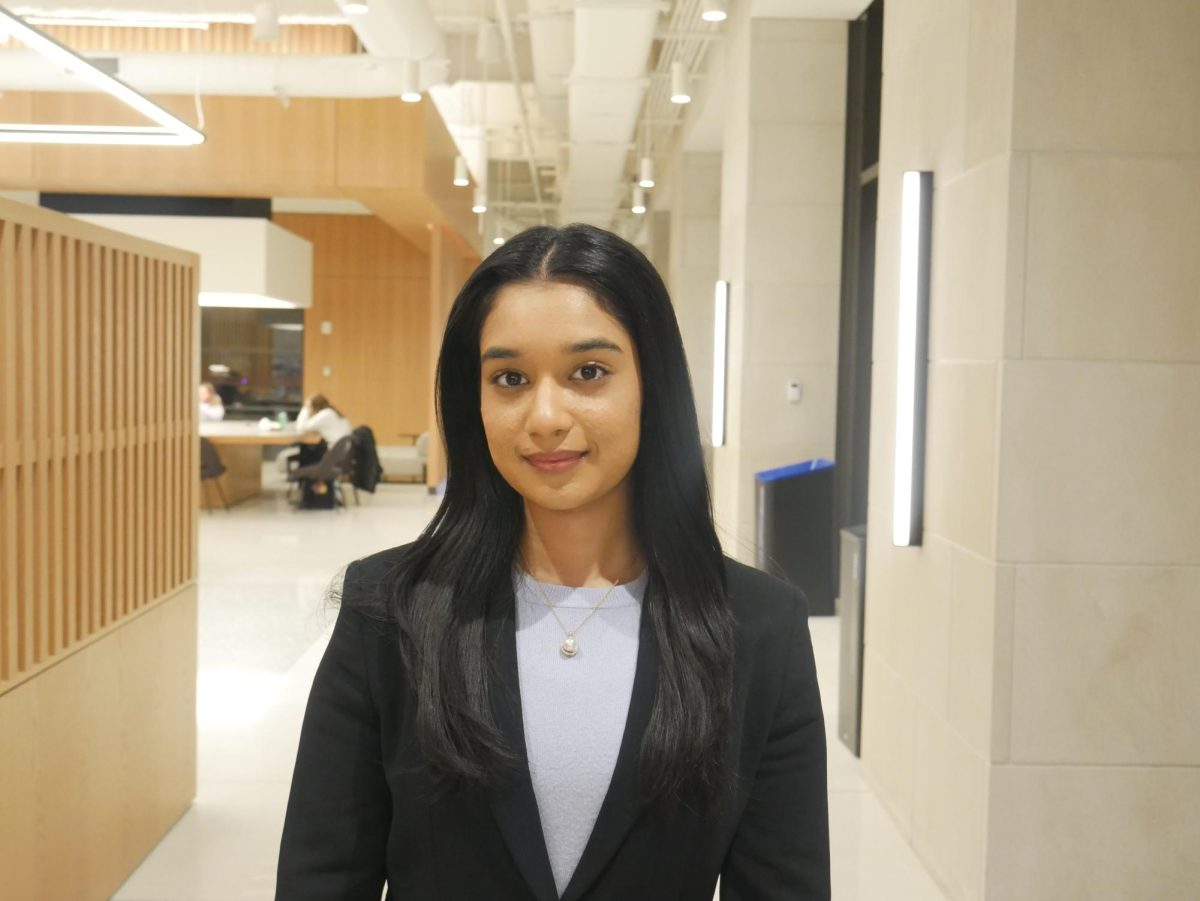
Emily Krebs, Ph.D., assistant professor in communication and media studies and director of the disabilities studies program, received an honorable mention. Their work is centered around sharing tools for accessible pedagogy.
“In short, that means creating and facilitating classes where everyone’s access needs—what they need to participate and learn at their highest potential—are meaningfully accounted for,” Krebs said via email.
In their work, Krebs strives to create courses that incorporate accessibility accommodations, without the need for further accommodations from the Office of Disability Services.
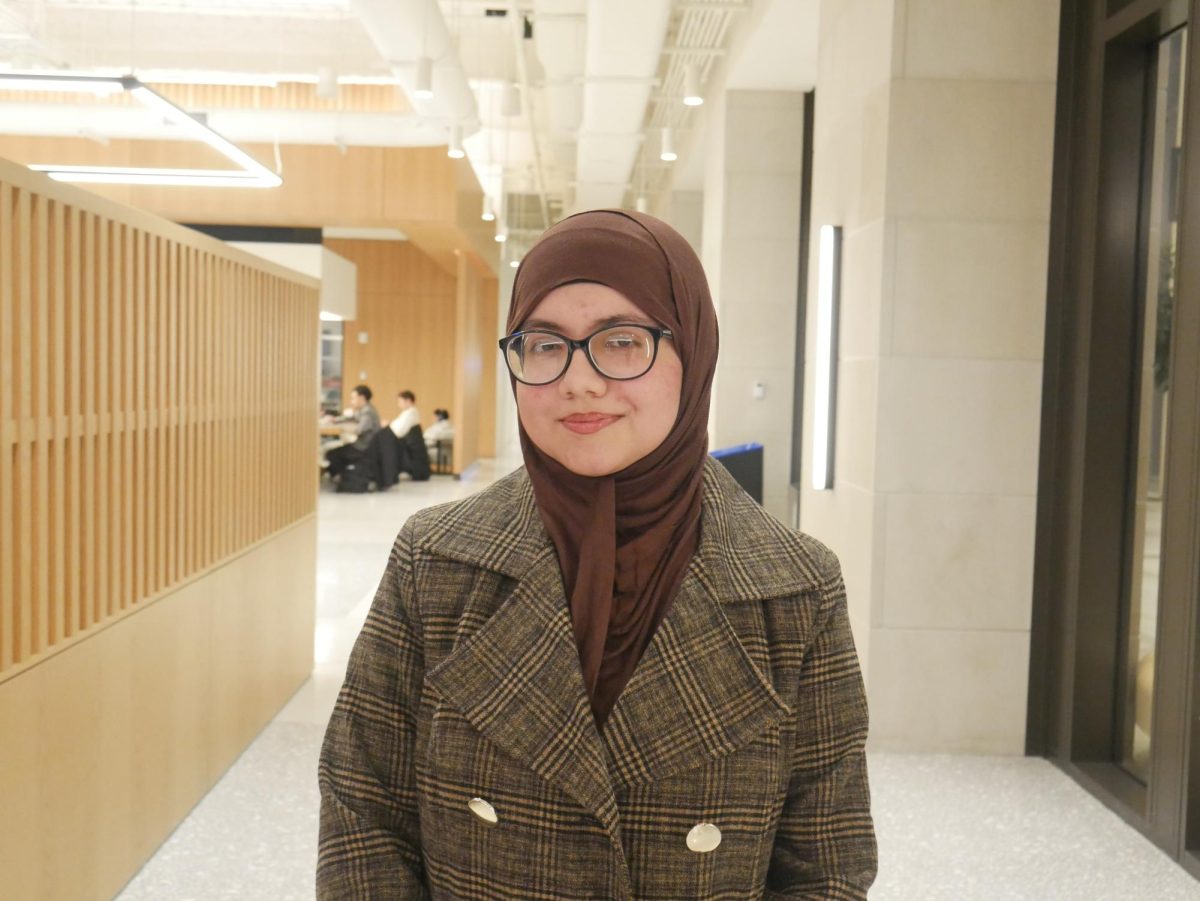
Andrew Simons, Ph.D., associate professor of economics, also received honorable mention for his work in teaching and creating the interdisciplinary course: Ecology and Economics of Food Systems.
“We teach foundational ecological and economic principles and introduce students to the concept of sustainability in food systems as a three-legged stool with the legs being environmental, social, and economic sustainability,” Simons said via email.
The overall model of the course posits that all three legs are necessary to achieve true sustainability. Four major world food systems are broken down in the course, including palm oil, maize, chicken and eggs and sugar.
The course also includes a volunteer component. In partnership with Fordham’s Center for Community Engaged Learning (CCEL), students volunteer for 15 hours with La Familia Verde, which helps facilitate Bronx-grown gardens. This includes seasonal crops, such as those found in vegetable markets, throughout the South Bronx. Students help to facilitate the entire set-up and take-down process, in addition to volunteering while the market is open.
Simons noted that he felt great about being honored at the ceremony, citing the nerves that come with creating a new class.
“You are nervous if students will even take the class, will they like it, will it be worth all the work, will you get to teach it a second time, or will it be a one-time flop, will our connections with the community be meaningful for students and meaningful to the community partners themselves?” Simons said.
He thanked his peer professors and university administrators for the positive reception of the course’s integration.
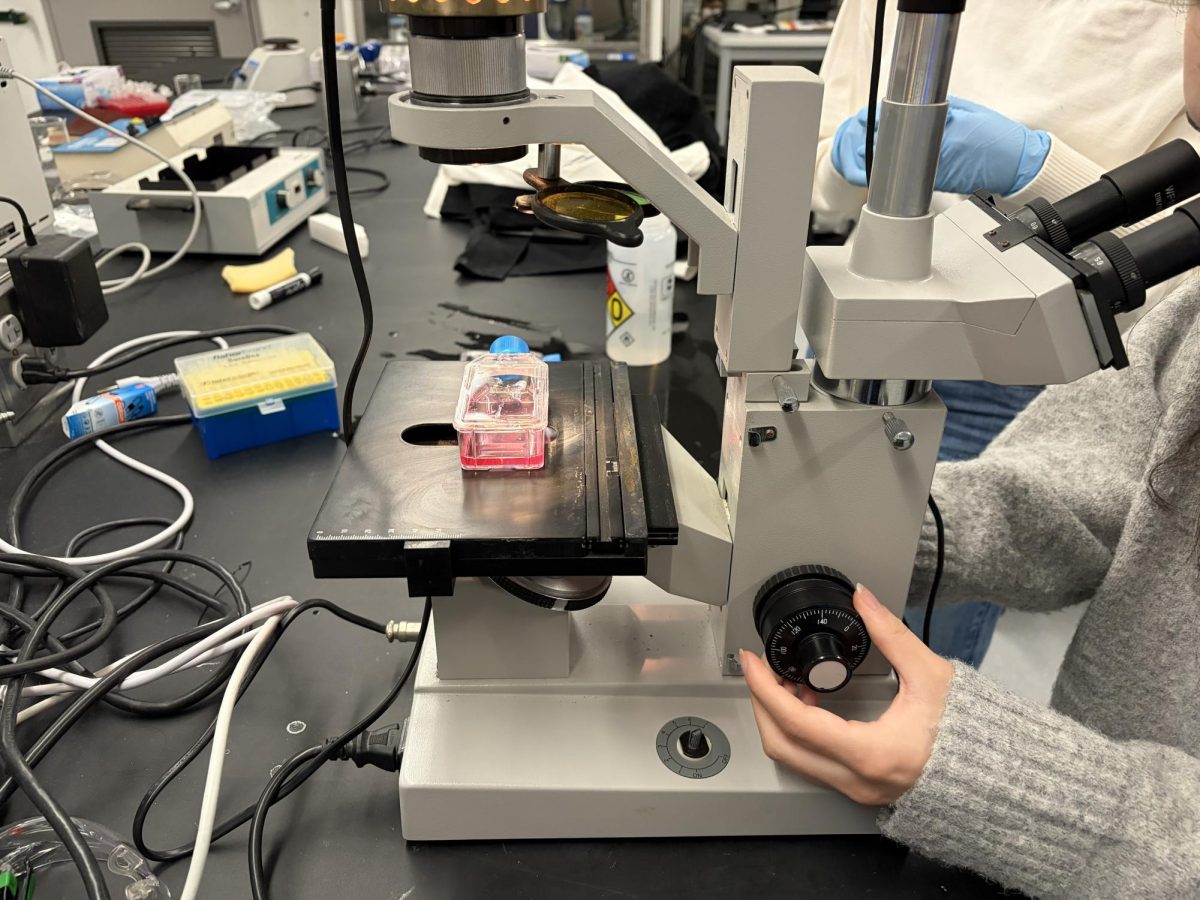
JD Lewis, Ph.D., professor of biological sciences, won the McGroddy Award in 2024 and was honored this year. They attribute their restructuring of the biology department for first-year students as a large part of the reason they won.
“This involved a suite of changes that hinged around reducing the content taught in Intro Bio I and II, by thinking of the content as a three-semester sequence including Genetics,” Lewis said via email.
Lewis’ work also strives to make the department more efficient for students.
“That enabled us to look at the first-year experience as really a two-year experience,” they said. “With the goal of having students complete the three-semester sequence by the end of their sophomore year.”
This new teaching style means more interactive learning sessions for students taking biology classes. For instance, students more inclined towards research may register for the research-focused section of Introductory Biology II, where they will partake in an additional challenge of student-led research.
Lewis said that they were overwhelmed and grateful for the opportunity to be honored.
“I’m blessed to work with so many other amazing faculty and grad student instructors,” Lewis said. “Much of what I’ve accomplished is from learning while I’ve taught with or sat in on classes by other instructors.”
They also extended their gratitude to McGroddy for creating the award.
The McGroddy Award comes with a $10,000 prize and was established in 2019.