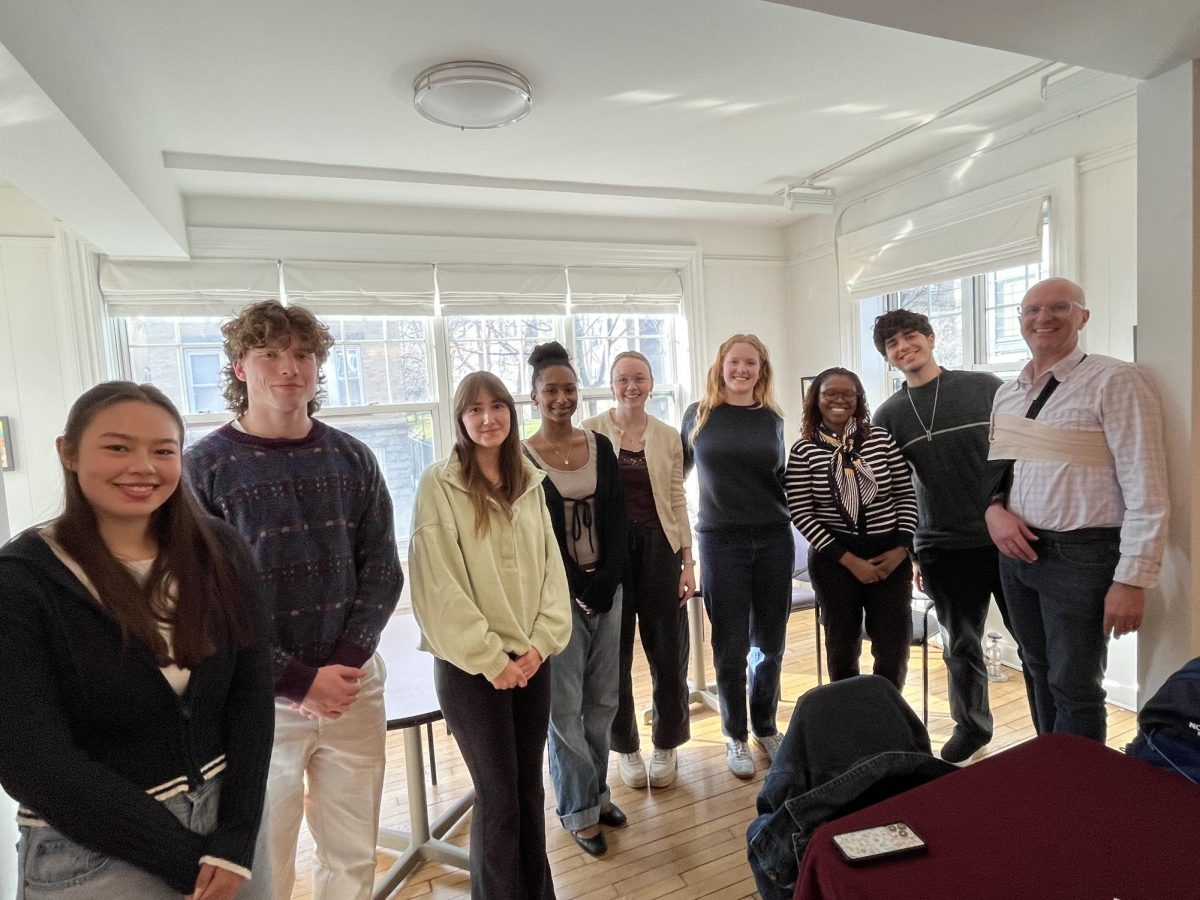


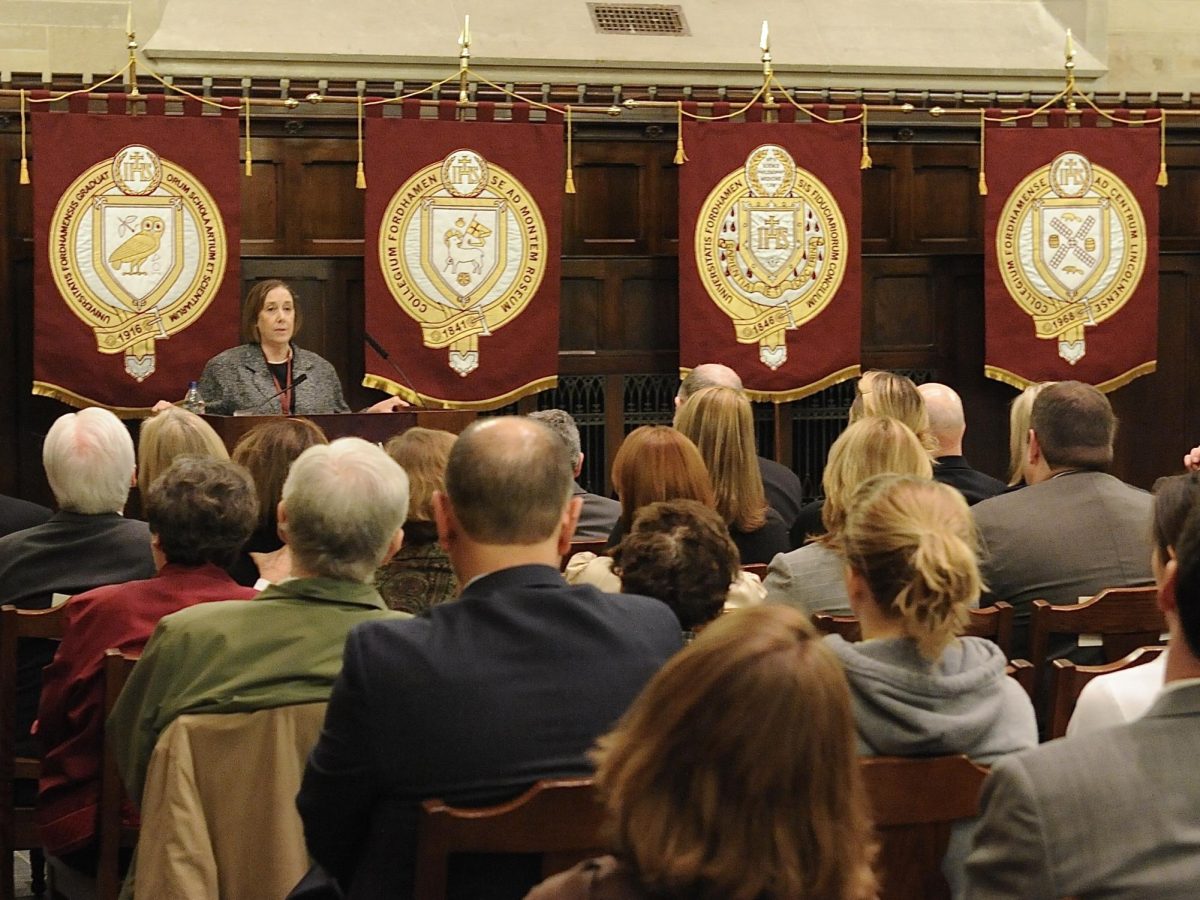












































































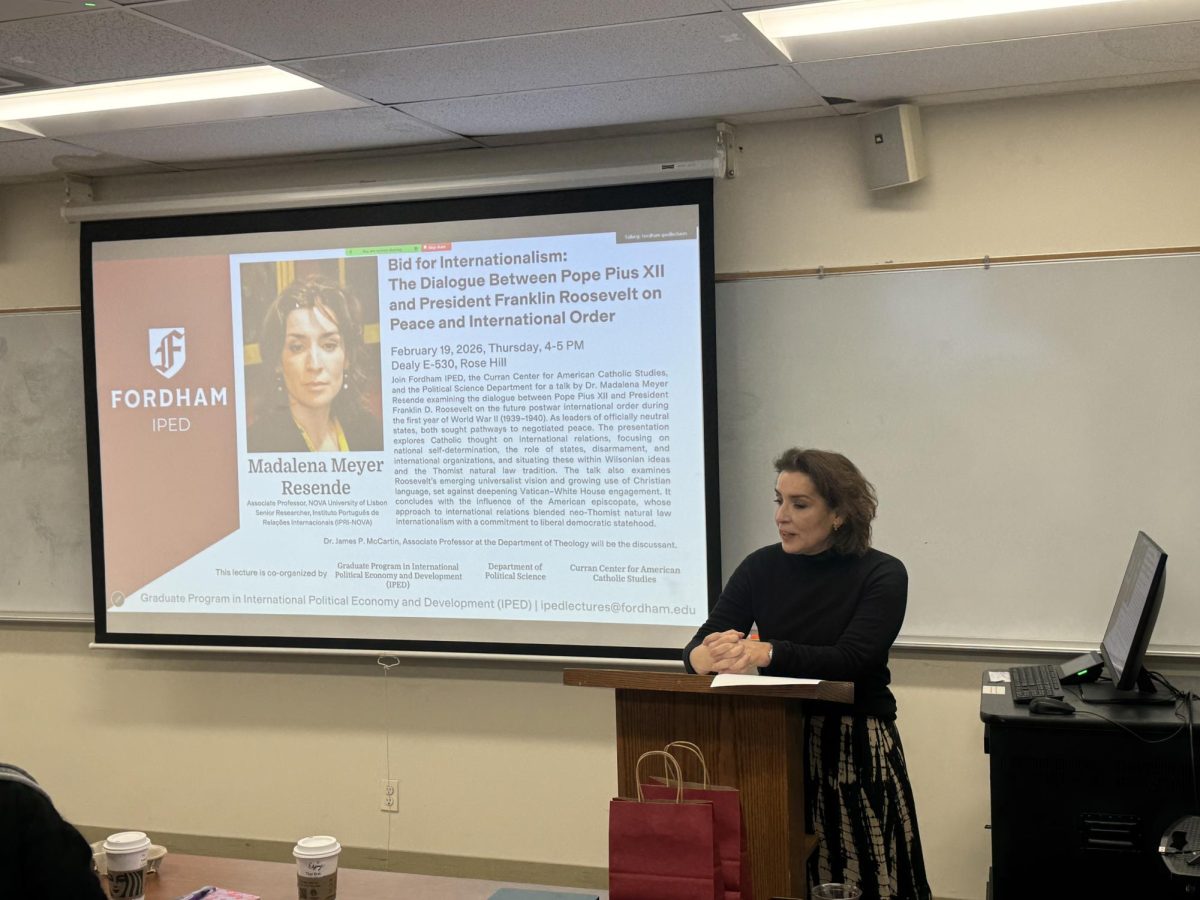
The Fordham University international political economy department (IPED) hosted an event as part of their weekly lectures titled, “Bid for Internationalism: The Dialogue Between Pope Pius XII and President Franklin Roosevelt on Peace and International Order.”
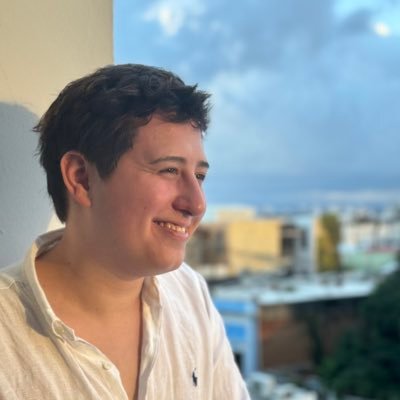
The lecture given was a collaboration between the political science department and the Curran Center for American Catholic Studies. Madalena Meyer Resende, Ph.D., an associate professor at the NOVA University of Lisbon and a scholar of Catholicism and also politics, presented on the topic of her new book, which covers the dialogue between Pope Pius XII and former President Franklin D. Roosevelt.
Resende had begun her presentation with framing the project within broader scholarship on the reformation of the international order, noting that major wars often prompt global frameworks that had been established by those victorious powers and highlighting the 1648 Westphalia System, the 1815 Vienna Congress and the 1918 Versailles system as highly relevant examples.
In the formation of the postwar international order, Resende had emphasized a less apparent “underground dialogue” between Washington, D.C., and the Vatican which had contributed to various emerging ideas that were about sovereignty, human rights and also multilateral institutions.
“The emergence of Nazi ideology and rapid expansion created within the Vatican the need for a new model,” Resende said. She added that this expansion led to the Vatican’s shift toward acceptance of the nation-states, individual rights and democratic governance.
Resende highlighted parallel developments in American policy that was under Roosevelt. Beginning in the late 1930s, U.S. internationalism moved toward universal principles that would apply globally, despite some strong domestic isolationist sentiment present. The speech given by Roosevelt in 1941, the “Four Freedoms” speech and the 1942 Atlantic Charter were also noted by Resende as milestones in defining individual rights as the foundation of postwar order.
At the same time, Pope Pius XII’s Vatican had been undergoing its own doctrinal transformation. A key turning point came in 1939 with the Pope’s letter “Summi Pontificatus,” which framed nation-states as legitimate actors within a natural rights-based international order. This statement marked a significant departure from earlier Catholic ambivalence toward the state system.
“It was one of the first doctrines that gave a positive twist on states and national sovereignty,” Resende said.
She noted that, early in the war, the Vatican and the United States shared temporary alignment as the neutral actors seeking to shape peace without direct military engagement. Resende explained how diplomatic cooperation had deepened through unofficial channels, including Roosevelt’s personal envoy Myron Taylor, who traveled repeatedly between Washington, D.C., and Rome. These exchanges addressed issues ranging from military strategy to religious freedom. Tensions emerged, however, when the Soviet Union had joined the Allied forces in 1941, raising concerns in the Vatican about communism’s expansion into Europe and the presence of an atheistic great power.
Religious liberty became a focal point of negotiations, which ultimately influenced the inclusion of religious freedom language in the 1942 Declaration of the United Nations. Resende said that this language demonstrated how the Vatican concerns shaped broader Allied policy discussions.
One of the more significant historical events Resende had examined was Pope Pius XII’s 1942 Christmas message that had been delivered amid the pressure on the Vatican to condemn Nazi atrocities. The address had articulated the “Rights of the Human Person” as the foundation of political and international order, that represented what Resende described as a major doctrinal shift in the Vatican’s consideration of the interplay between states and individuals.
“It puts individual rights, or rights of the human person as it is written at the center of political order of states and international order of states,” Resende said. “It is the most well known Christmas message.”
Later the wartime debates focused on the structure of postwar security institutions, particularly whether global governance should be regional — i.e., dominated by major powers —or universal. The Vatican supported universalist models, partly due to fears that regional arrangements would strengthen atheistic Soviet influence in Europe, and impinge religious liberties, which Resende had explained guided Vatican policy towards the United States.
By the war’s end and the founding of the United Nations in 1945, Catholic political thought had undergone a very significant transformation. Resende noted that, while the Vatican expressed reservations about aspects of the new system, it had largely aligned itself with American-led liberal internationalism, abandoning earlier ambiguities about democracy and sovereignty.
The presentation concluded by emphasizing the role of American Catholic bishops as intermediaries who had then translated ideas between Washington, D.C., and Rome. Their influence, Resende said, helped produce a new synthesis combining Catholic doctrine with elements of the liberal democratic internationalism.