

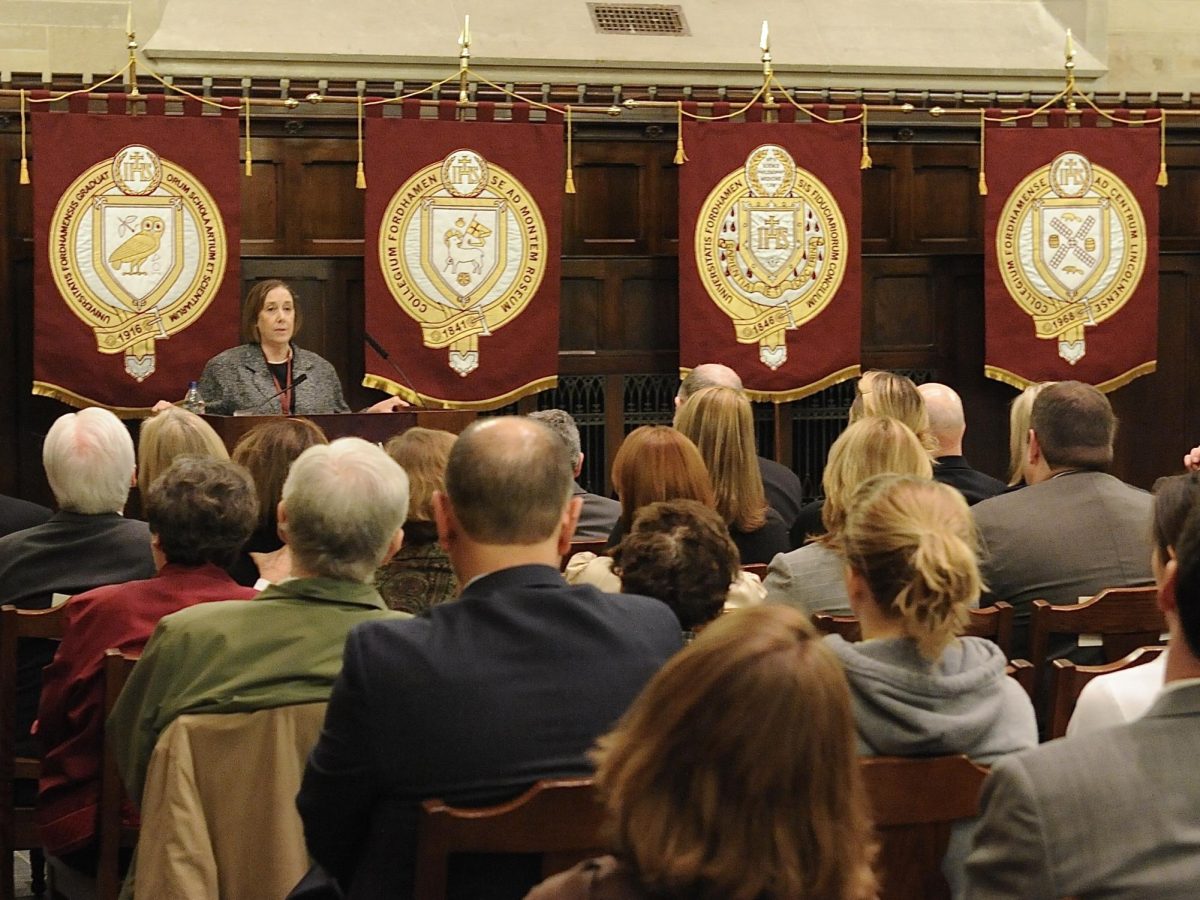












































































































































































Professor Katrin Kogman-Appel, Ph.D., of the University of Münster delivered the first lecture in a multi-part lecture series on Feb. 25, presenting “The Book and the Seder: Medieval Evidence of Passover Rituals.” The three-part Distinguished Lecturer series, which is being held by the Fordham University Center for Jewish Studies, explores the evolution of one of Judaism’s ritual texts.
Kogman-Appel, a leading figure on medieval Hebrew illuminated manuscripts and various early printed books, has spent decades studying Jewish book culture. Much of her scholarship focuses on the Haggadah, the text used during the Passover Seder to recount the biblical Exodus from Egypt. While many Jewish families continue to use the Haggadah today, Kogman-Appel’s research reveals that its historical development was far from static.
“The more I get to know this field, the more I realize that there remain numerous questions open,” she said.
The series, which is being led by Kogman-Appel, which covered her nearly-completed research project, examines how the Haggadah emerged as a distinct book type around the 14th century and how its design, imagery and function shifted during the transition from manuscript to print culture.
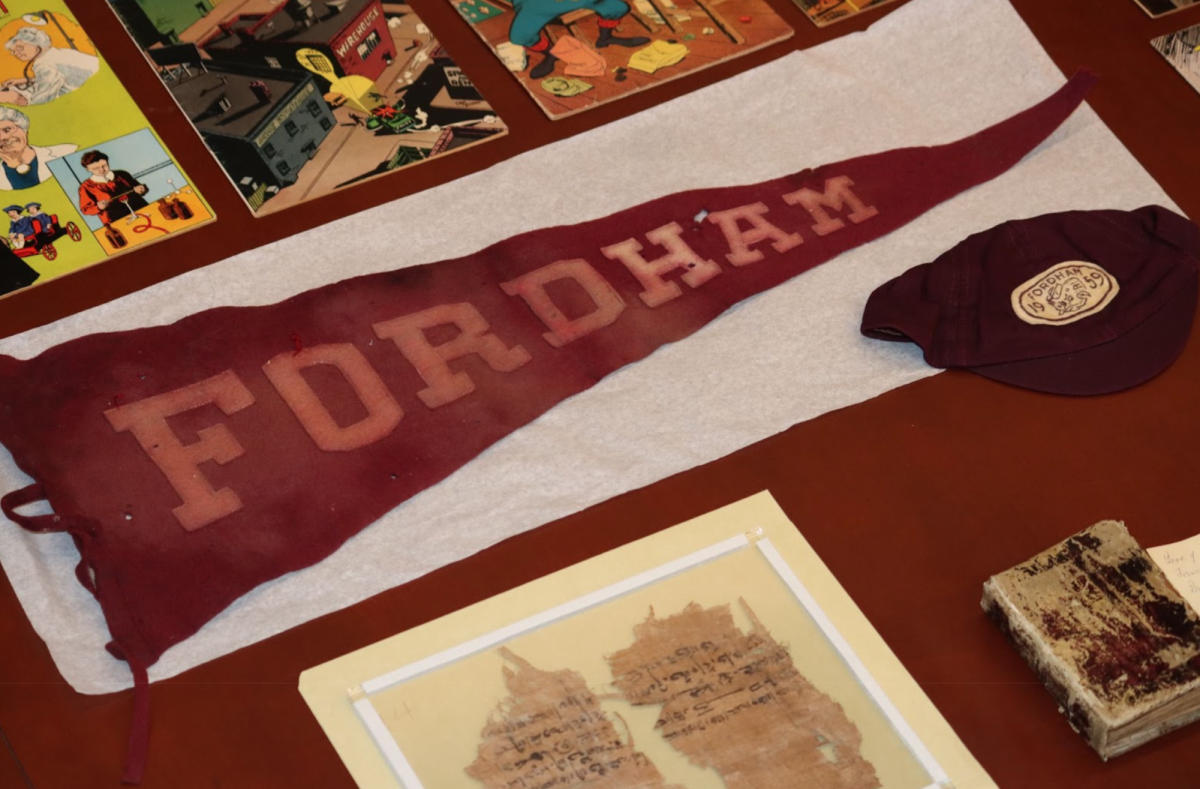
Aside from its primary topic, this lecture series highlights Fordham’s own resources. In addition to the lectures, Kogman-Appel led a workshop using 17th-century printed books and some high-quality facsimiles of the medieval manuscripts from the Fordham’s Special Collections.
Passover centers on the ritual meal known as the Seder, had intended to inspire identification with the Israelites’ liberation from slavery in Egypt; a Haggadah serves as a guidebook for this retelling. Medieval Haggadot — many of them lavishly illuminated — offer insight into how Jews in Europe understood and performed this ritual centuries ago. These illustrated manuscripts, as according to Kogman-Appel, had frequently contained unexpected visual elements that complicate assumptions about uniformity in practice.
Kogman-Appel’s academic career spanned institutions within Israel, Germany and in the United States. After many years at Ben-Gurion University of the Negev in Beer-Sheva, she now holds a research professorship at the University of Münster. She has also lived and worked in Pittsburgh and also Princeton, New Jersey, which she said has allowed her to bridge intellectual traditions across Europe, Israel and the U.S.
Kogman-Appel’s personal interdisciplinary approach reflects that transnational experience. As she had been trained in Jewish studies, she said she was drawn to illuminated manuscripts as a student first encountering the field.
“Given that the majority of medieval book art is religious, the path to ask questions about ritual practice was a short one,” she said.
“Book culture is a huge part of our own lives,” Kogman-Appel said. “Recognizing that connection can help students see medieval artifacts not as distant relics, but as objects embedded in the social and religious practice.”
The event underscored the broader value of medieval studies within the academy.
“Any kind of history is important,” Kogman-Appel said. “Medieval culture and its religious history is part of who we are today and without understanding it, we won’t be able to properly define our own identities. The same applies to studying other cultures’ past — the more we know about their past, the easier it will be to understand them.”
That message resonates particularly in the context of Jewish life in medieval Europe, which had unfolded within multi-faith societies governed by Christian and, in parts of Spain and the Middle East, the Muslim authorities. As according to Kogman-Appel, investigating Jewish manuscripts from this period can reveal those stories. The Jewish studies department said that studying these sorts of events is important for reminding us of both the possibility and rich precedent of coexistence.
“Inquiries into the Jewish past always will tell stories of interfaith exchanges, dialogues, conflicts, and harmonies [as] models for social co-existence,” the Jewish Studies Department told the Ram.
For students encountering Haggadot for the first time, she said that one can approach the Haggadot from multiple angles. Art history students may be drawn to their aesthetic features and iconography; those studying religion might focus on theological context; students interested in social history can examine ownership, readership and the sociology of texts.
“Book culture can perhaps open up students who encounter this field for the first time to connect to it,” Kogman-Appel had then said.