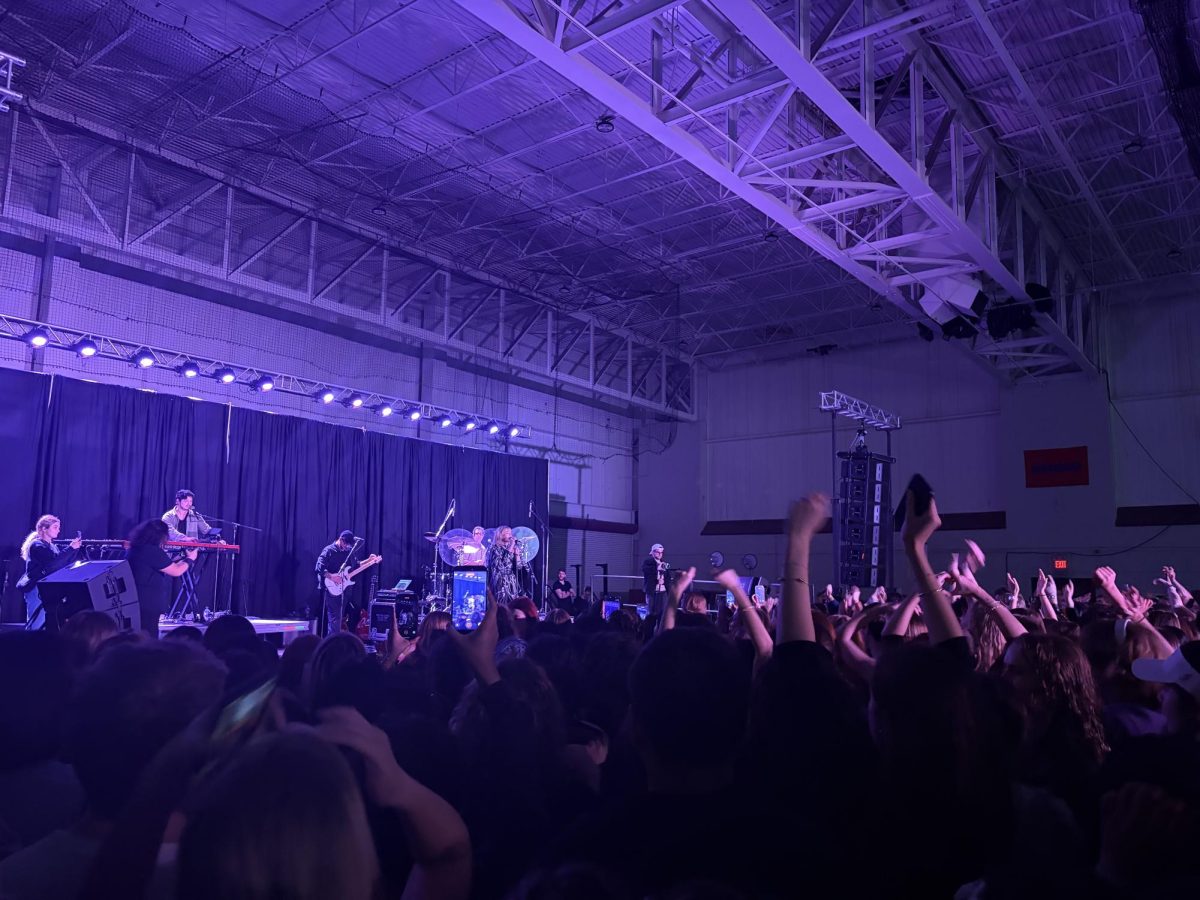


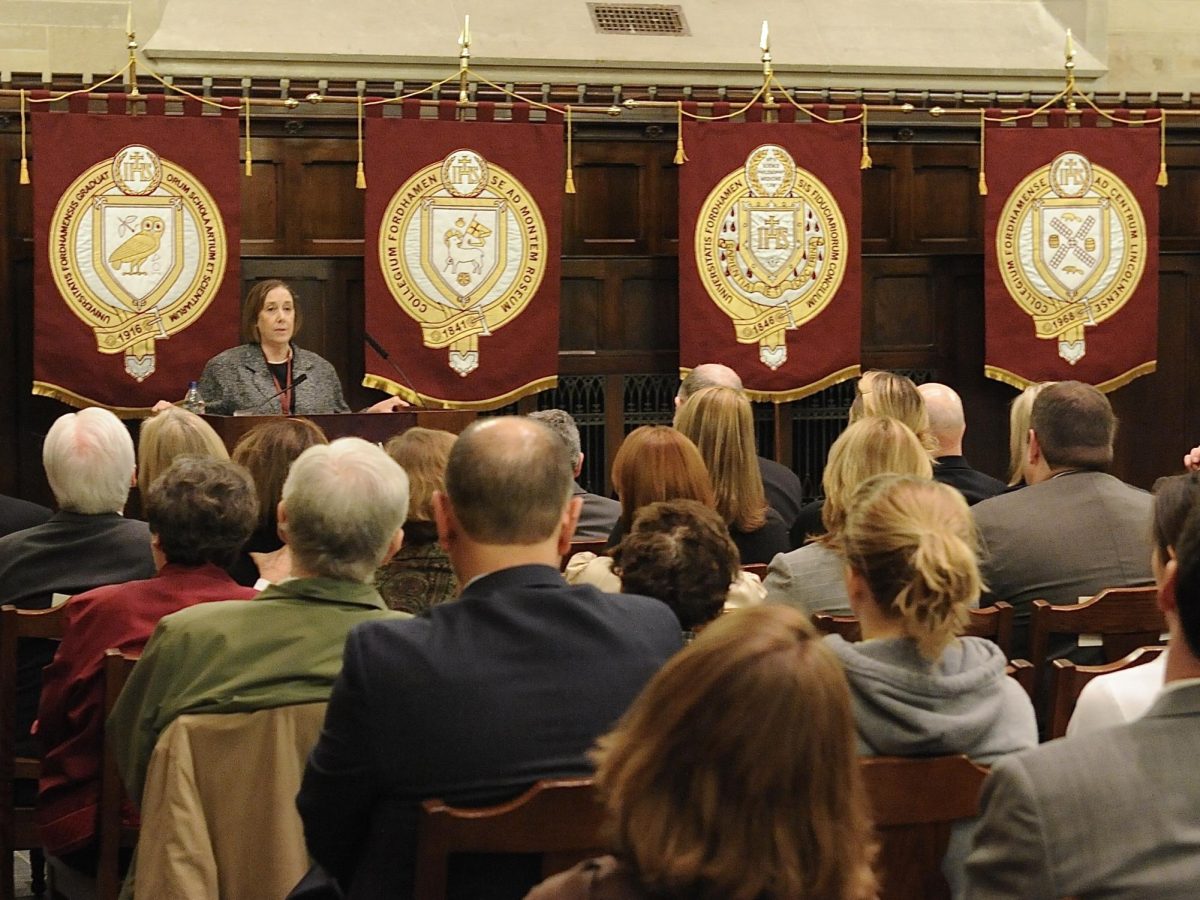






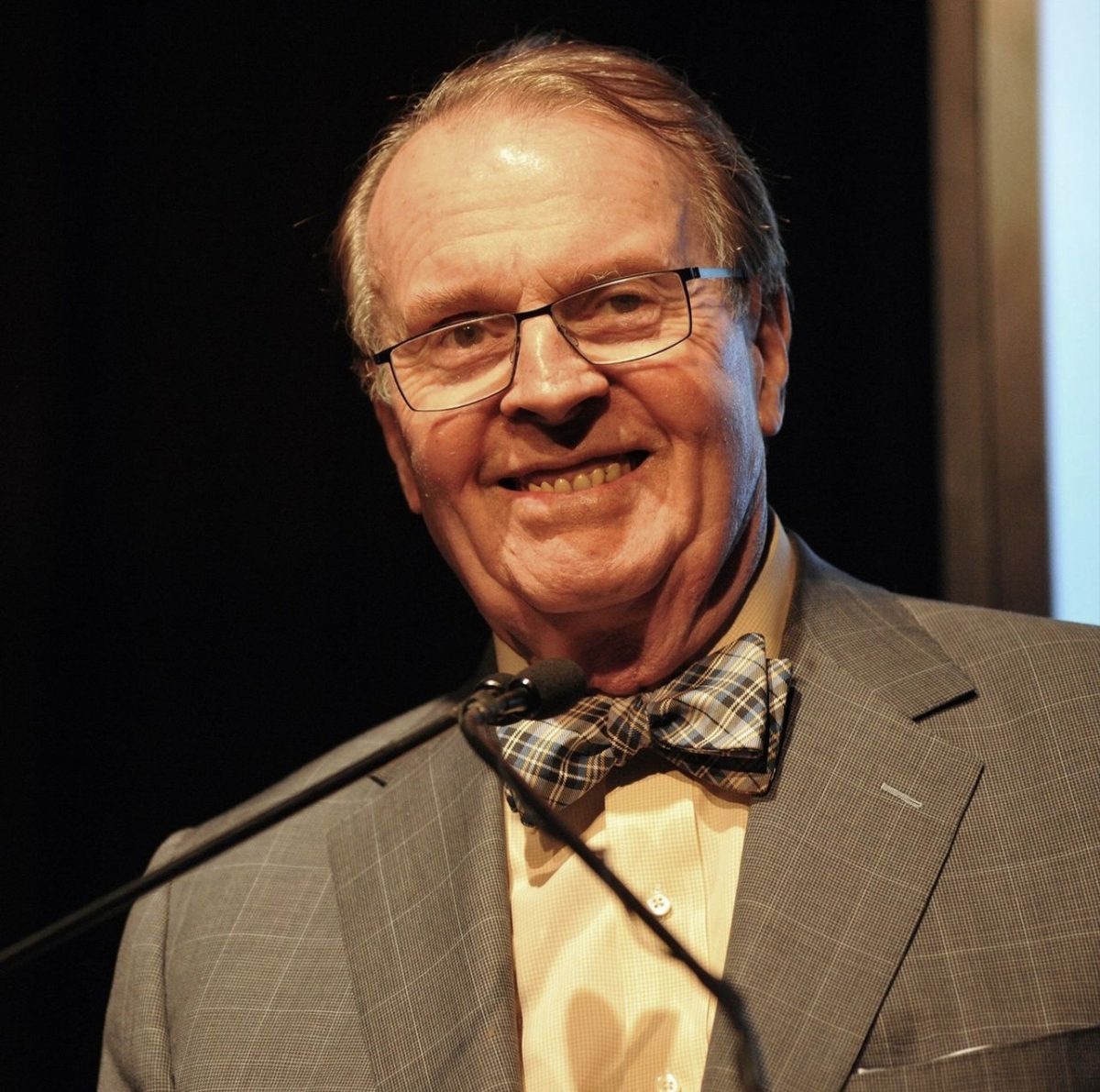



















































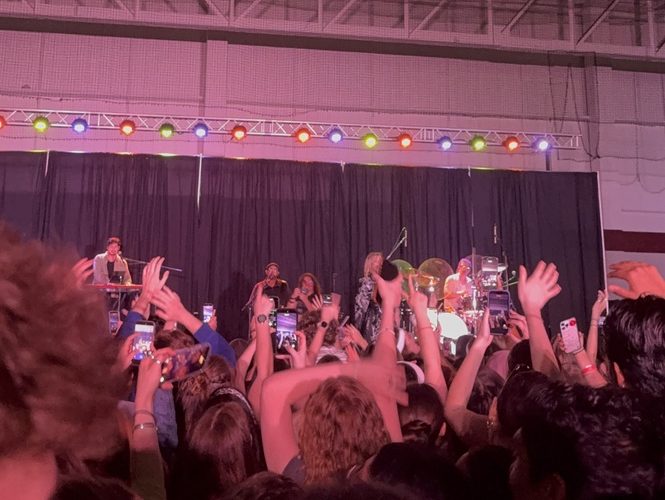







































































Jordan Fisher, Broadway and Hollywood actor, singer and dancer who is known for his roles in Disney’s “Liv and Maddie” and “Teen Beach Movie,” as well as his Broadway roles as Evan Hansen in “Dear Evan Hansen” and Orpheus in “Hadestown,” spoke at Fordham University on Feb. 26 about his experience as a Black person in the acting, production and musical theatre industries.
The event was a part of the annual Black History Month keynote event held by Fordham’s Black Student Alliance (ASILI). Each year, ASILI works with various speakers from the organization American Program Bureau to find a candidate based on their desired budget and profession of interest, according to the President of ASILI Maya Persico, FCRH ’26. Past speakers have included notables Monique Coleman, Ilyahsa Shabazz and Kevin Richardson.
The event was held in collaboration with the Campus Activities Board (CAB), with further support from the Office of Student Involvement, Office of Multicultural Affairs and Residence Halls Association. The event was also part of CAB’s American Age Lecture Series, which aims to highlight diverse and impactful voices to engage Fordham students with new perspectives and individuals who have shaped national discourse, according to CAB President of Operations Emma Seber, GSB ’26.
To start the event, the Public Relations Manager of ASILI, Naomi Walters, FCRH ’27, introduced Fisher by highlighting the achievements of his career as well as their significance during Black History Month.
“Jordan Fisher is one of those rare performers who doesn’t simply inhabit a role, he transforms it,” Walters said. “He brings a level of passion and presence that commands attention. In this month, when we celebrate black excellence and the ongoing work of creating equitable spaces in every industry, Jordan’s journey embodies both achievement and advocacy.”
In true musical theater fashion, Fisher walked onto the stage singing “Do You Want to Build a Snowman” from Disney’s “Frozen,” calling back to a decade-old studio performance of the song which featured several Disney Channel stars, including Fisher.
To start the Q&A, Persico asked Fisher about the Black artists in theater, film and music who inspire him, to which he mentioned Buddy Bolden, Nat King Cole, Luther Vandross, Whitney Houston, Michael Jackson, Sammy Davis Jr., Donald Glover, Denzel Washington and RuPaul as major influences.
“All Black artists inspire me,” Fisher said. “There are so many wonderful examples of people that kept their head tucked and succeeded in silence, and now we get to celebrate them. And that’s the kind of legacy building, I think, that really is of value to me.”
Persico then asked how Fisher brings his identity and perspective to characters who are not necessarily written with racial identity in mind. Fisher explained that when it comes to the portrayal of characters in media, they are often assumed to be white, even if their race isn’t explicitly mentioned. He said that he is guilty of these preconceived notions himself, but that through the portrayal of these characters by Black actors, we can eliminate the idea that only white people can assume these roles.
Fisher also explained that regarding characters who are characterized as being white or have historically been played by only white actors, there is often a belief that Black people cannot inhabit that role effectively, because of their racial and ethnic background. He said that by bringing people of color into those roles, people will start to see that stories can still be honored regardless of the background of the actor.
Specifically, he referenced his personal experience playing Anthony Hope in “Sweeney Todd” alongside fellow Black actor Nick Christopher, who played Adolfo Pirelli, marking the first time these characters were both played by Black actors.
“The beauty of acting is that you are taking the skin of another character, another thing, and you’re completely submitting to that,” Fisher said. “And hopefully that suspends reality for long enough for people to just be a part of the story, and receive something.”
Fisher added that he believes that when a story is told by a Black person, it adds another layer of impact and importance. He also said that it takes people like him playing these roles to eliminate the barriers that prevent people of color from being represented in storytelling.
“That’s why I speak at colleges,” he said. “To eliminate the smoke in the mirrors [about] whatever preconceived notion we have about us not being able to do something because of what we see in the mirror. It’s not true. It might take you a little bit longer to get there. But it can happen and it will happen.”
Persico also asked Fisher about his recent shift to producing with projects like “Hello, Goodbye, and Everything in Between,” and in particular how having a Black artist in a producer role impacts the stories that are told.
“There aren’t many of us doing it,” Fisher responded. “There need to be more.”
Fisher said that he got into producing after years of watching known producers like Mark Platt and Adam Siegel. He also said that it was a few specific colleagues in the industry who empowered him to pursue producing. But he explained that the reality of producing, especially as a Black person, is that it is not always easy and you have to be okay with your ideas being shot down, but that you have to keep speaking up and pursuing new projects.
“Oftentimes it comes with doing projects and feeling like you’re not being valued and feeling like you have things to prove and you’re not getting the opportunity to do it. That’s where I say succeed in silence. That’s where I say work and do the work, and when you have good ideas, speak up,” Fisher said. “If you just observe and you show up and you do the work, you will see some fruit on the other side of that.”
Fisher said that although a year and a half ago he could not have imagined himself producing a theatrical project, he now has five theater projects in development.
He ended by emphasizing the need for more people of color to speak up and pursue their passions, and that it takes collective action to truly make change.
“I just think that more of us, I’m looking at all the people of color in here specifically, not that I’m not talking to anyone else, but I am, more of us need to speak up,” Fisher said during the talk. “More of us need to be collaborative, more of us need to sit down and dream and scheme, and then take the idea and do things to make it happen.”