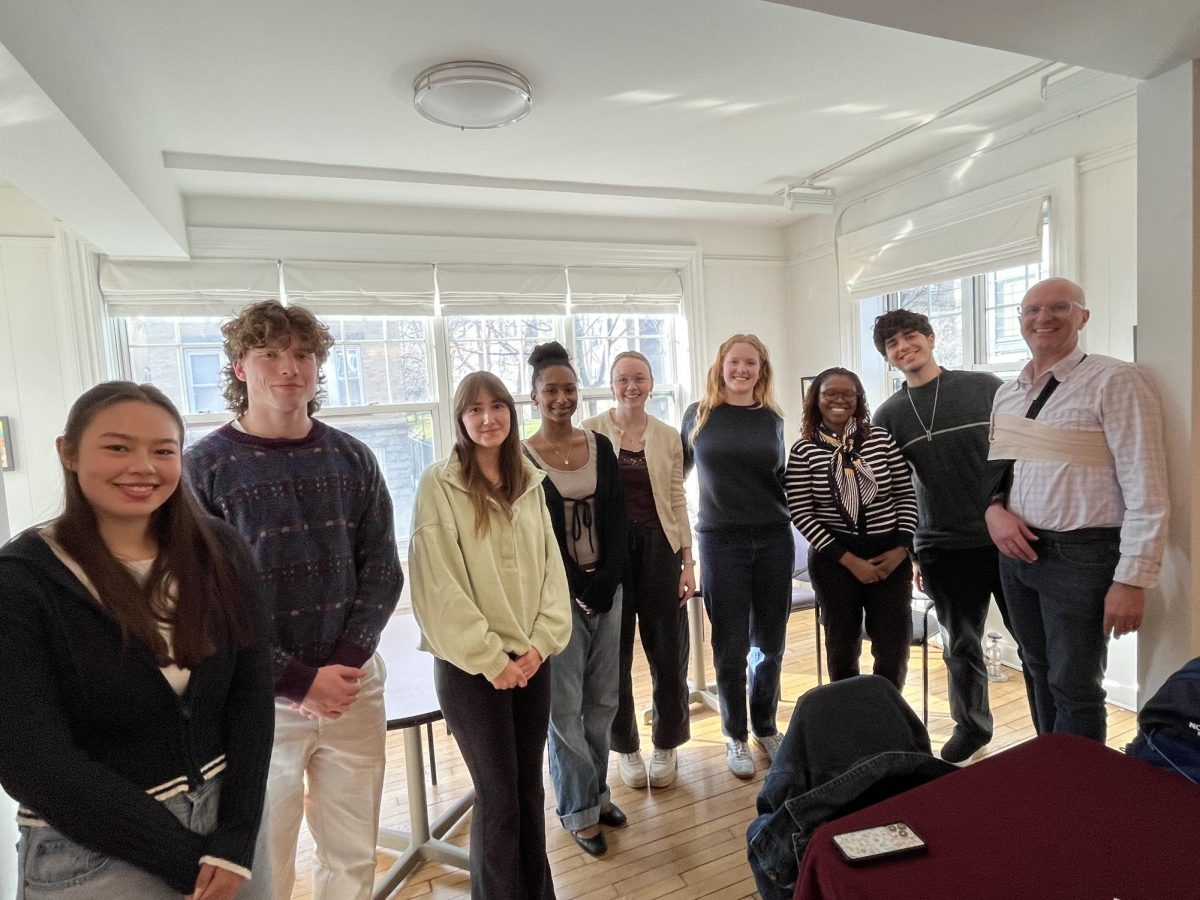


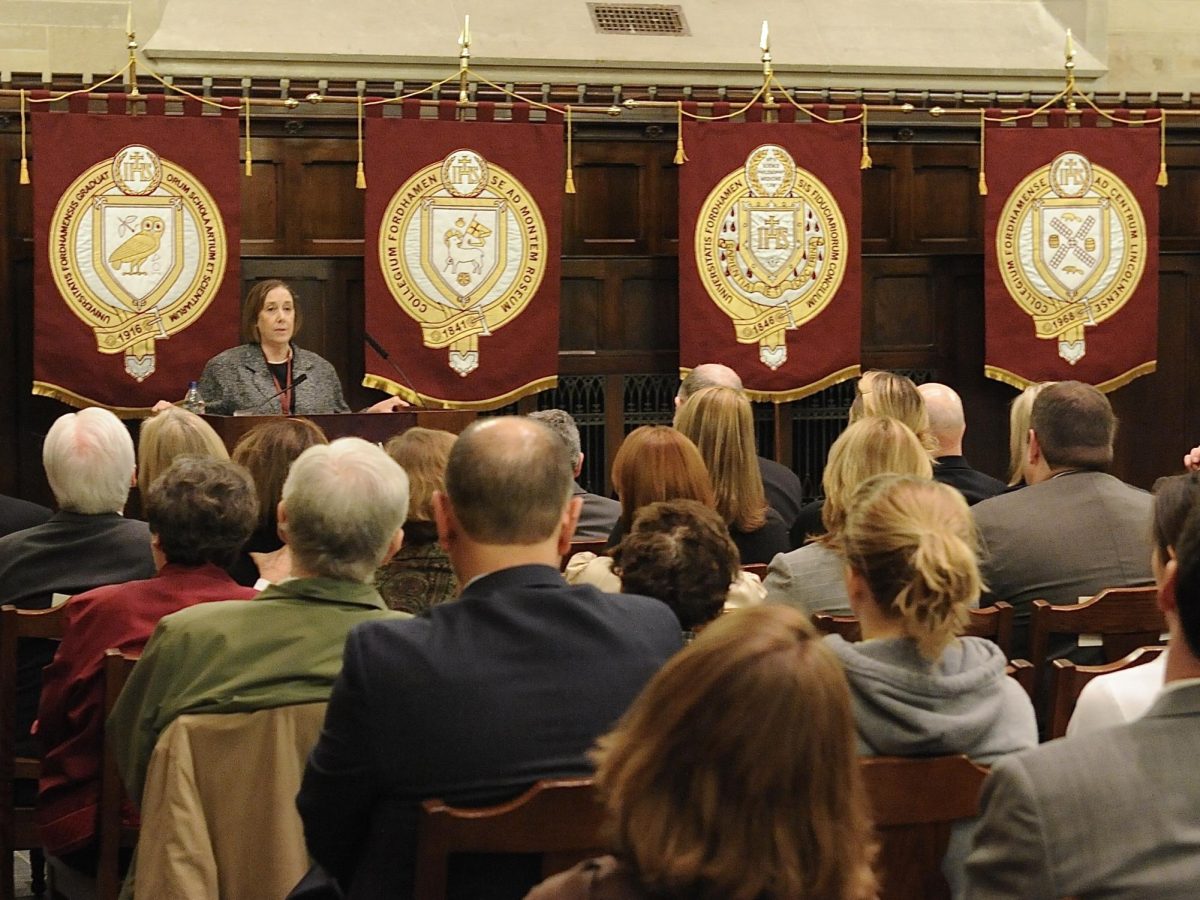





























































































































































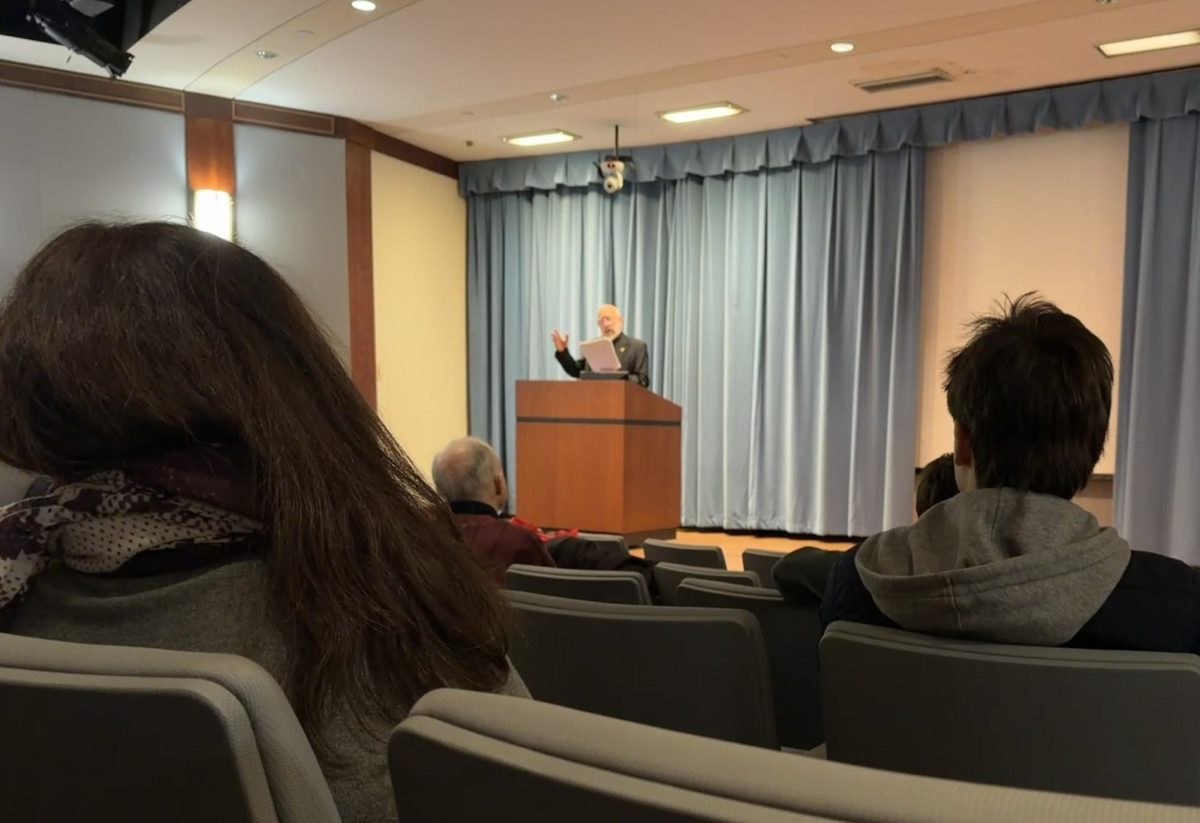
The Laurence J. McGinley Chair in Religion and Society Thomas Massaro, S.J., just presented a lecture focused on secularization and the role of religion in society on Feb. 25. The lecture was followed by a brief response by associate professor of sociology and anthropology Evelyn Bush, Ph.D.
Massaro began his McGinley lecture by discussing Émile Durkheim’s reductionistic view of religion, Sigmund Freud’s view of religion as an illusion and also Peter Berger’s role of the Protestant Reformation in secularization. Massaro then identified the Protestant Reformation alongside the rise of modern nation states and the scientific revolution as major developments in the process of secularization within society.
Massaro also noted Jose Casanova’s “Public Religions of the Modern World” when countering the secularization theory.
He then explored the idea of resurgence of religious influence in global politics, such as Roman Catholicism, Islamic activism, the Hindu nationalism and Evangelical Christianity, and how the de-secularization of the world has implications for religious leaders and institutions.
Massaro also then explained the ideas as presented in Charles Taylor’s “A Secular Age” by sharing the focus on its subjective aspects of modernization and the human condition and how this shift from a God-centered understanding to a humanist one affects the social concept of religion.
In terms of the decline of religion, Massaro noted the introduction and increased popularization of “spiritual, but not religious” individuals. He went on to compare the increased religious nature of Gen Z and the increase in individuals who don’t align with an organized religion.
Massaro had specifically referenced Sheila Larson from the 1985 work, “Habits of the Heart: Individualism and Commitment in American Life” which was written by Robert Bellah alongside Richard Madsen, William Sullivan, as well as Ann Swidler and Steven Tipton. Larson was a young nurse who had a faith she had deemed, “Sheilaism.” Larson was a spiritual, but not religious type who was documented by the authors in their work.
“Her self described personal philosophy of Sheilaism is replicated many millions of times over by people in our highly individualistic era of modernity, in which religious affiliation is no longer part of ordinary social expectations,” Massaro had said. “Still, there is reason for traditional believers to find much encouragement in such accounts as acknowledging this dynamic as a legitimate manifestation of religiosity may constitute the most benevolent possible interpretation of a secularization process.”
Massaro also commented on some noted issues with statistics about the number and the overall amount of those individuals involved in any religion, specifying that it is difficult to study secularization using surveyed data due to the inaccurate results.
“It’s extraordinarily hard to marshal adequate data to support any particular set of conclusion, whether one’s intention is to document the triumph of secularism, or to debunk the case with a sharp decline of religion,” Massaro said. “But even the researchers who conduct these quantitative studies know well that there are patterns of thought and behavior that lie well outside the realm of data.”
To conclude his lecture, Massaro noted that doubt assists religion instead of harming it.
“We should all recall that insight that doubt is a healthy part of faith, maybe an indispensable part of a faith life that is honest and open to new evidence,” Massaro said. “The most prudent advice is to continually re-examine the judgements that we make about the state of religion today, and be willing to, as they say, trouble the narrative of secularization.”
Bush followed up with her response to Massaro’s lecture by discussing secularization specifically within the 21st century and focused on the intersection of technology with religion. She brought up the idea of artificial intelligence and how it takes human creation and subjects them to reorganization via rationalization.
After Bush’s brief and concise commentary, there was a Q&A segment.
Massaro asked a question of the audience. He wanted to know about the religious involvement of Gen Z from those in the audience who either knew more or were a part of Gen Z.
David Carvar, FCRH ’27, commented on the polarization in the world in regards to other aspects of society and related it to the discussion of religion and secularization.
“I think we can all see is becoming increasingly polarized as a large state, kind of in tune with our nation, we’re becoming very polarized in a lot of different aspects,” Carvar said. “A large part of that is political polarity, and a lot of that leads through into religion, I feel like, because we see a lot of politics, part of the platform used is religion as a base for that.”
Massaro said there would likely be another McGinley Chair lecture in the upcoming 2026 fall semester.