

























































































































































































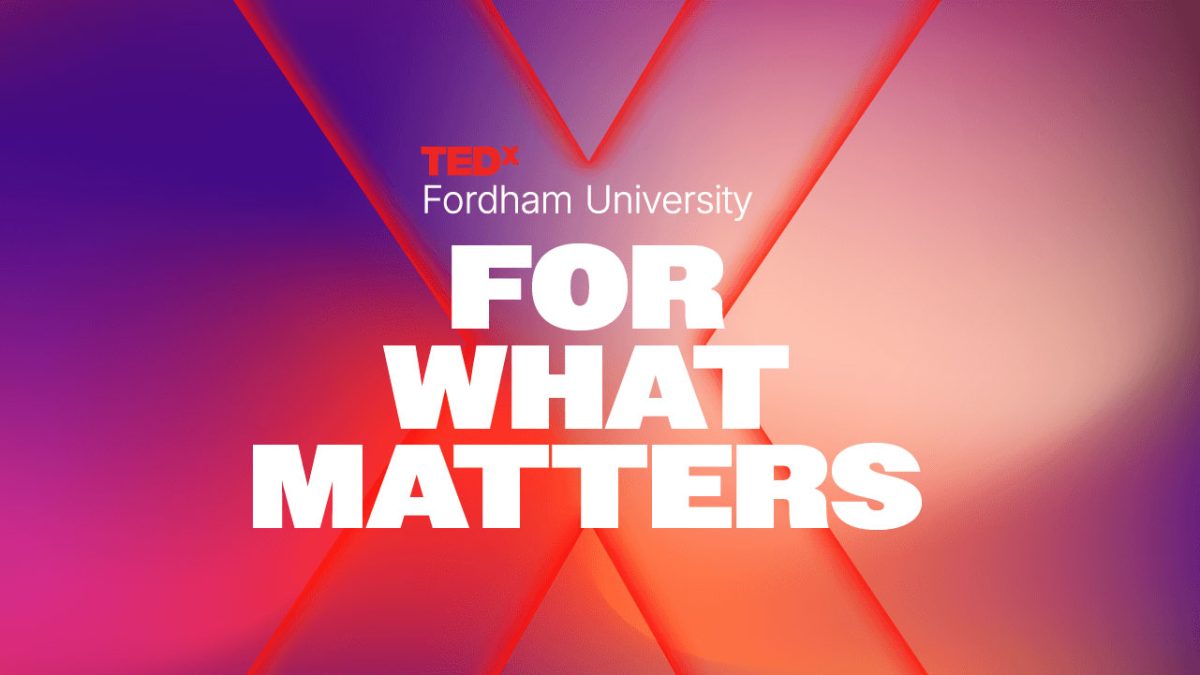
Fordham University hosted a TEDx event where speakers, connected to Fordham as faculty or alumni, from various industries gathered to examine some of the most difficult challenges and ideas shaping modern society. The talk, which took place on March 26, covered topics including AI and entrepreneurship.
Commencing the program, entrepreneur Brandon Kim, FCRH ’15, reflected on the realities of building a business from the ground up alongside his brothers. Kim, who is the co-founder of Brevitē, a lifestyle brand, described the emotional and operational challenges that accompany the rapid growth of a business, including moments of acute financial instability and conflict.
“It stops being about one thing and starts being about everything,” Kim said during the talk, recalling a crisis point when his company faced significant debt and was forced to downsize.
Kim introduced the concept of “the trap,” a framework which describes some of the psychological pitfalls that can hinder success. He identified three primary types: the martyr who glorifies overwork, the ‘magpie’ who is distracted by constant new opportunities and the ‘pressure cooker’ who is overwhelmed by scale and expectations. According to Kim, recognizing and addressing these patterns is essential to maintaining focus and long-term sustainability.
“At any given moment, there are only a handful of real problems to solve,” he said.
Shifting the focus of the talk from entrepreneurship to public health, Chief Executive Officer emeritus of Northwell Health Michael Dowling, MSW, GSS ’74, addressed what he described as the urgent social crisis affecting the younger generations. Highlighting data that positions gun violence as the leading cause of death among children in the United States, he called for collective action and policy reform.
“This is a public health issue,” he said. “The statistics are staggering. This is a health issue and we see it in our organization, we see it in our mental health facilities, we see it in our emergency apartments, we see it in our family practices.”
Dowling also raised concerns about the psychological effects of social media, particularly among adolescents. Increased rates of anxiety, depression and social isolation, he said, are linked to excessive digital engagement. “Actually, the teens are telling us about it. Teens 13 to 17 are telling us that it affects sleep, it affects their productivity, it affects their mental health, and it enhances social isolation,” Dowling said.
While acknowledging the benefits of technological advancement, he warned of the “nasty underbelly,” of this same advancement, referring to its downside, and called for stronger regulation and public awareness.
“We cannot [leave] the resolution … alone in the hands of the wizards of technology,” Dowling said. Additionally, AI emerged as a central theme throughout the event, featuring faculty expertice in business and machine learning, as well as philosophy. They discussed how AI is reshaping learning environments and workforce expectations.
“Students should not use AI to replace learning, but to facilitate [it],” said Associate Professor of the Gabelli School of Business Yilu Zhou, Ph.D.
Zhou discussed the integration of AI into students’ lives both in and out of the classroom, and prioritized the need for students to develop foundational knowledge in addition to technical fluency.
She also highlighted the importance of adapting currently existing educational systems to integrate AI more effectively, moving beyond traditional exams and more toward experiential learning models which better account for the new capabilities that AI brings to students.
“Along this line, for example, students can acquire verbal knowledge and skill sets, very much like a project manager to manage AI agents,” Zhou said. “This includes evaluating their work to make sure the deliverable doesn’t have any AI hallucination or AI bias, as well as sliding their workflow and also direction.”
Another lecturer at the event was Assistant Professor of Philosophy Sam McGrath, Ph.D., who examined AI from a different angle, describing it as a “mirror” for understanding human cognition.
“How is it that the neural network that we have running between our ears can realize and instantiate this kind of structure?” McGrath said. “That is precisely the kind of question that contemporary AI can help us to answer.”
Drawing on concepts from neuroscience and computer science, McGrath explained that artificial neural networks can model aspects of human reasoning, offering insights into the way language, perception and unconscious processing function in our own brains. At the same time, he noted that differences between AI and human thought may reveal uniquely human capacities, such as creativity or consciousness.
“Artificial intelligence promises to offer a sort of a new vantage point on a whole set of questions that us philosophers have really been knocking our heads against,” said McGrath.